Earth
Every Brief story that names Earth, gathered from the outlets that covered it.
- Stories100
Every story
All Earth news100
Every story that names Earth, newest first.
UN climate summit ends without a final decision for the first time since 2009.
Pope Francis’s diary recounts three encounters with the devil.
U2 adds 15 North American stadium shows to its 2027 tour.
Georgina Long shares a national science prize for melanoma research.
Two online databases expose more than 3.5 billion personal details.
Germany takes seriously unconfirmed reports Russia may launch a nuclear-armed satellite later this year.
A research team finds the most distant close pair of objects lit by black holes ever seen.
Simulations suggest a hypothetical planet could explain unusual orbits beyond Neptune.
The European Space Agency’s Hera probe reaches the asteroid pair hit by NASA’s test.
EPFL researchers model the heating power fusion plasma needs to reach H-mode.
Xi says China-Australia relations have made a comprehensive turnaround.
A European-Japanese spacecraft reaches Mercury, on course to be only the second mission to orbit it.
Show 85 older stories
November 2026Sydney researchers find the Milky Way’s central bar may form stars along gas waves.
University of Queensland physicists send a message through a brick wall using gravity.
Alphabet shares rise 2.2% after Google’s Blue Origin AI-satellite deal.
Satellite scans reveal a buried Saite-period structure beneath Egypt’s Mound of the Pharaohs.
Researchers use NIF’s first L-edge X-ray method to measure compressed tantalum’s temperature.
Physicists model how a star’s destruction could reveal asteroid-mass primordial black holes.
Astronomers discover a triple-star system with no comparable system known within 100 light-years.
An Ethiopian volcano released the first confirmed methane outburst of its magnitude without erupting.
Endangered Australian bogong moths use Earth’s magnetic field to navigate when starlight fails.
Nvidia’s board rules out Jensen Huang’s return as CEO after 33 years.
Voyager 1 becomes the first human-made object to reach one light-day from Earth.
Grand Theft Auto VI is set to launch after a 13-year wait.
China builds a nearly three-kilometre runway on disputed reef, its second in the Paracels.
A new model explains West Antarctica’s unusually rapid bedrock rise.
Researchers identify 29 Martian deposits that may be ancient glaciers, with cliffs up to 209 meters.
Firefly agrees to a $1.3 billion rocket deal to help AST challenge SpaceX.
Iridium activates satellite service with claimed 100% global coverage.
Netflix sets January 14, 2027 release for 3 Body Problem Season 2.
Orbital wobbling makes an exoplanet disappear from view.
Euclid releases the largest space-based sky map of its kind.
Space42 starts production of a phone combining satellite data with 4G and 5G.
The Princess of Wales joins Prince William for her most high-profile foreign trip since cancer treatment.
United Launch Alliance’s Vulcan rocket suffers its first mission failure.
Rory McIlroy wins his eighth Race to Dubai title to match a European Tour record.
Australia beats New Zealand 32-12 to win its fourth consecutive men’s Rugby League World Cup.
Caltech’s ASTRA robot makes the first astronaut-free structure in space.
A study finds 280-meter-deep underwater canyons helped preserve South Australia’s Ediacaran fossils.
A new study suggests changing conductivity explains Uranus and Neptune’s unusual magnetic fields.
Researchers find Flinders Ranges canyons helped preserve some of Earth’s earliest complex life.
Fossil hunters find a sauropod skeleton from a poorly understood phase of the Cretaceous.
Australian and New Zealand crew survive fatal firefighting helicopter crash in Indonesia.
COP30 and COP31 presidents launch climate accelerator with Exeter as its sole university partner.
Scientists recognize 12 coral species previously treated as variants as distinct.
Researchers develop the first open-source toolkit showing heatwaves threaten Europe’s power supply.
Astronomers link eight-minute radio pulses to the first detected white-dwarf system with a Sun-like star.
A study finds Earth’s cryosphere has moved beyond its planetary safe operating space.
Ukraine says Starshield’s 161-kilometer-per-hour limit is disrupting drone interceptions.
Jensen Huang resigns as Nvidia CEO amid affair allegations involving a suspected Chinese intelligence asset.
Perth CSIRO team gives the famous black hole image its first truly independent validation.
Euclid releases its first major data batch, covering more than 900 million galaxies.
Study identifies low Arctic winter sea ice as an early clue to Eurasian summer drought.
A study finds West Antarctic glaciers retreated far inland in temperatures like today’s.
The Liberal Party drops its Williamstown candidate over offensive comments about Indigenous Australians.
Russia proposes a 374-satellite network to compete with Starlink.
WHO classifies 2026–2027 El Niño health impacts as a first-ever health emergency.
Global fossil-fuel emissions are projected to fall 0.4% in 2026.
M. John Harrison, 81, becomes the oldest-ever Booker winner for The End of Everything.
Researchers find some El Niños may be predicted accurately up to 12 months ahead.
SpaceX plans to catch both Starship stages, including its upper stage for the first time.
A Turkish steelworks blast leaves 16 dead, up from an earlier reported toll of six.
Gunman kills six in Kraków’s Main Square, a major tourist hub.
The Antarctic ozone hole reaches about 90% of its largest-ever size at its 2026 peak.
Kate Miller-Heidke announces a 2027 tour with four Western Australian shows.
A strong central Japan earthquake injures at least 22 people.
Pope Leo begins a 12-day South American tour weeks after lung cancer surgery.
Experts say over 99 per cent of Australian children meet protein needs without supplements.
Artemis II launch creates three ionospheric disturbances that could affect GPS.
LIV Golf is shutting down for a lack of financing and player commitments.
Inquest examines six children’s deaths involving a jumping castle held by four pegs.
A study finds the world’s wettest storms deliver half of annual rain in shorter bursts.
NextDC shares surge more than 40% during investors’ attempt to buy up to 9.9%.
COP31 aims to turn climate pledges into practical results.
Researchers propose rising and sinking continents explain Earth’s rock-record gap spanning over a billion years.
Earth has captured a 3-foot space rock as a temporary mini-moon.
Democrats win both chambers of Congress in a midterm setback for Trump.
COP31 will bring climate negotiators to Türkiye under an unusual Australia-Türkiye leadership arrangement.
NASA’s Swift telescope is expected to re-enter after nearly 22 years in orbit.
CERN physicists find evidence of a decay predicted around once in every 10 billion beauty particles.
Blue whale sightings fall dramatically in the Galápagos during El Niño.
A business jet crashes into a Florida neighbourhood, killing all nine aboard.
UN-backed reports warn of potentially irreversible ice loss beyond 1.5C warming.
October 2026Hackers steal an estimated $US6.3 billion from Binance in the largest crypto hack on record.
Star Trek and X-Men actor Sir Patrick Stewart dies at 86.
A UN report finds the largest documented restoration effort covers 252 million hectares.
Research finds a deep Antarctic water layer reversed decades of freshening in years.
King Charles begins Caribbean tour by acknowledging slavery’s injustices.
WMO reports record 2025 levels for three major greenhouse gases.
Poll finds 78% of Australians oppose letting AI use creative work without permission.
Australia’s first newly built international airport in more than 50 years opens Sunday.
Almost all assessed shallow-water reef ecosystems face extremely high collapse risk by 2075.
Independent MP Helen Haines is left critically injured after a car strikes her in Wangaratta.
SpaceX reports $US14.6 billion in quarterly revenue, beating analyst expectations.
Longyearbyen has kept its tap water officially undrinkable for the past year.
Elon Musk says he will give every US child one SpaceX share in 2027 that would cost more than US$10 billion.
A magnitude‑2.8 earthquake struck near Tanunda and drew nearly 250 reports.
About
About Earth
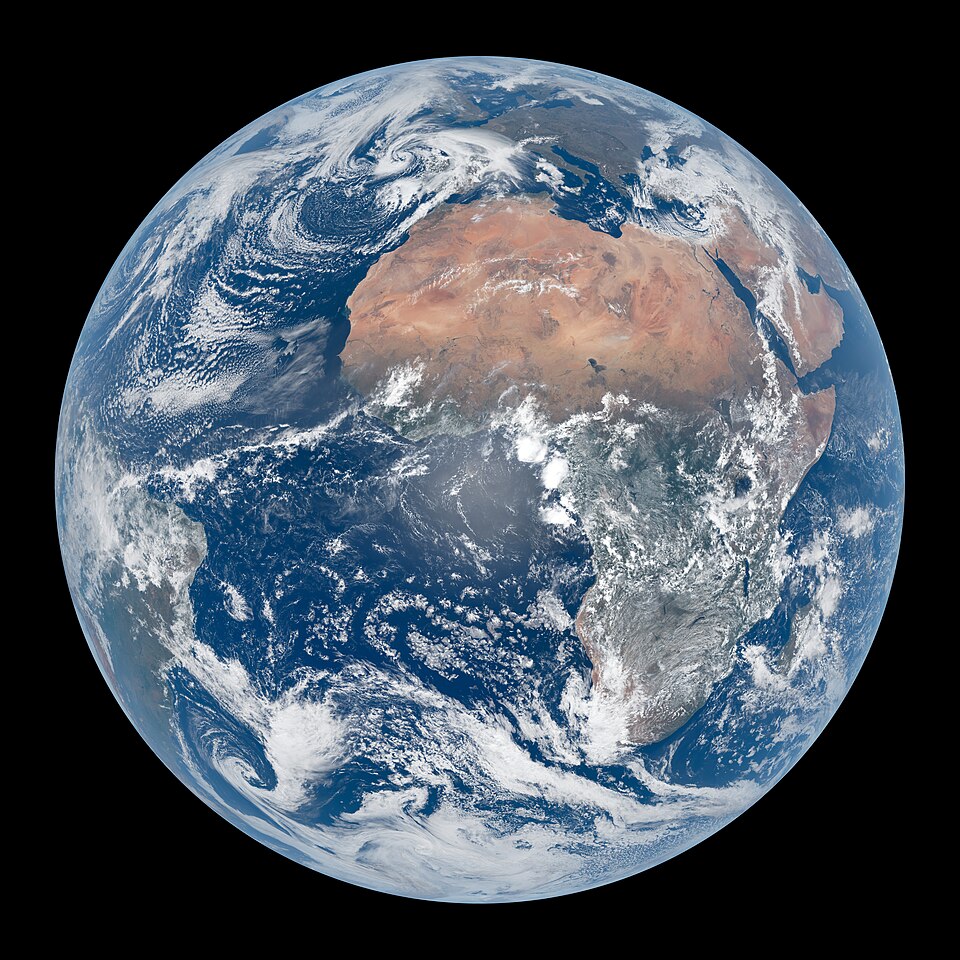
Earth is the third planet from the Sun and the only astronomical object known to harbor life. This is made possible by Earth being an ocean world, the only one in the Solar System sustaining liquid surface water. Almost all of Earth's water is contained in its ocean, which covers 70.8% of Earth's crust. The remaining 29.2% of Earth's crust is dry land, which is predominantly located within Earth's land hemisphere in the form of continental landmasses. Most of Earth's land is at least somewhat humid and covered by vegetation, while large ice sheets at Earth's polar deserts retain more water than Earth's groundwater, lakes, rivers, and atmospheric water combined. Earth's crust consists of slowly moving tectonic plates, which interact to produce mountain ranges, volcanoes, and earthquakes. Earth has a liquid outer core that generates a magnetosphere capable of deflecting most of the destructive solar wind and cosmic radiation.
Read more on Wikipedia ↗