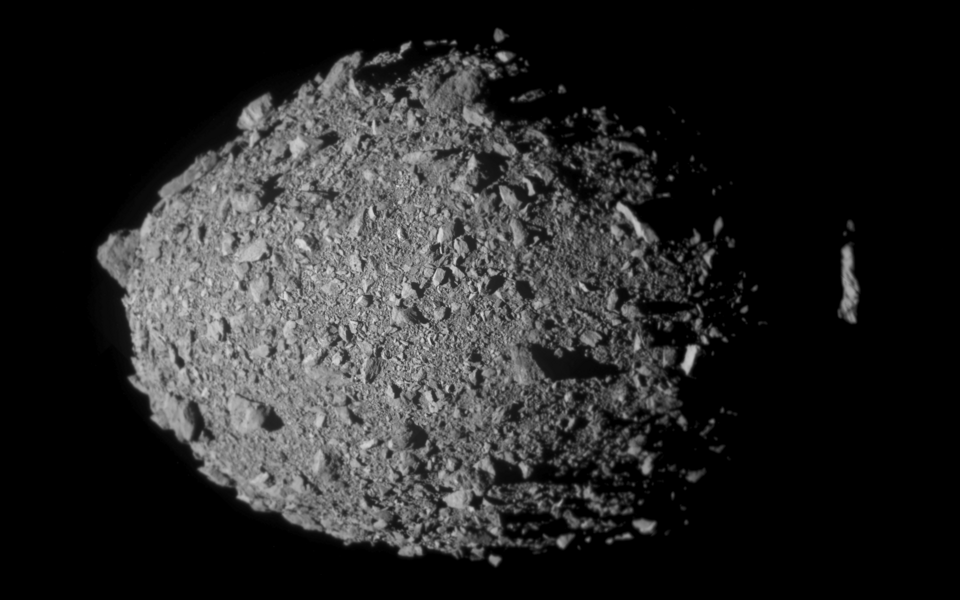
The European Space Agency’s Hera probe reaches the asteroid pair hit by NASA’s test.
The ’s Hera probe has reached the vicinity of Didymos and its smaller companion, Dimorphos, to examine the pair.
’s DART spacecraft hit Dimorphos nearly a year after launching in late 2021, to test whether an impact could change an asteroid’s path. The collision shortened Dimorphos’s orbit by 33 minutes, more than scientists had hoped, partly because debris from the impact pushed it further.
Hera will investigate the impact site and determine Dimorphos’s exact mass to help assess how effective the test was. It will also be the first detailed exploration of a pair of asteroids.
Sources 1
- W
WIRED
Scientists had hoped that the impact of the probe—which was barreling toward the asteroids at over 13,000 miles per hour—could shorten the period of the mini-moon's orbit by a minute or more
↗ - W
In the end, it was slowed down by 33 minutes
↗ - W
This major deviation was caused by the ejection of debris, leading to a much greater recoil than what was produced by the impact itself
↗
About
The European Space Agency is a 23-member international organisation devoted to space exploration. It has its headquarters in Paris and a staff of around 3,000 people globally as of 2025. ESA was founded in 1975 in the context of European integration. Its 2026 annual budget was around €8.3 billion.
About
The National Aeronautics and Space Administration is an independent agency of the U.S. federal government responsible for the United States' civil space program, as well as research in aeronautics and space. Headquartered in Washington, D.C., NASA operates ten field centers across the US and is organized into three mission directorates: Human Spaceflight, Research and Technology, and Science. Established in 1958 amid the Space Race, NASA succeeded the National Advisory Committee for Aeronautics (NACA) to give the US space program a distinct civilian orientation focused on peaceful applications. Since then, it has led most American spaceflight programs, including Project Mercury, Project Gemini, the Apollo program, Skylab, the Space Shuttle, the International Space Station (ISS), and the ongoing multinational Artemis program.