Astronomers link eight-minute radio pulses to the first detected white-dwarf system with a Sun-like star.
The detected 214 pulses from the source between December 2024 and September 2025.
The companion star has almost the same mass and temperature as the .
Researchers say the pulses are visible only when the stars align in the right way.
Sources 3
- GRare Star System Emits Radio Signals Every 8 MinutesFri 13 Nov, 7:50am↗
Gizmodo
- TA dead star is flashing radio waves every 8 minutes, and its partner looks a lot like the SunThu 12 Nov, 9:06pm↗
The Conversation (AU)
- MRare Star System Emits Radio Signals Every Eight MinutesThu 12 Nov, 11:00am↗
miragenews.com
- G
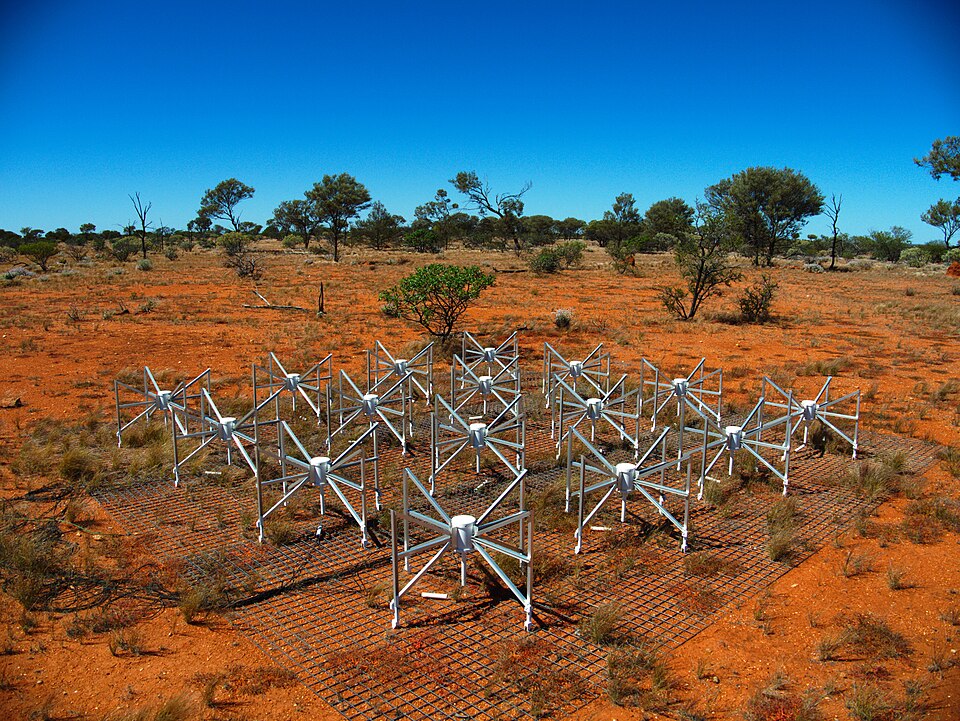
Beginning in late 2024, the Murchison Widefield Array (MWA) in Australia detected GPM J071507−114153
↗ - T
In late 2024, we were looking for new long-period transients using the Murchison Widefield Array radio telescope in Western Australia
↗ - G
From December 2024 to September 2025, the MWA detected 214 pulses from the source
↗
Astronomers link mysterious radio pulses to a binary system containing a white dwarf and a Sun-like star.This story
Orbital wobbling causes an exoplanet to disappear from view around its host star.→ 18 NovAbout
The Sun is the star located at the centre of the Solar System. It is a massive sphere of hot plasma, heated to incandescence by nuclear fusion reactions in its core, radiating the energy from its surface mainly as visible light and infrared radiation, with 10% at ultraviolet energies. It is the main source of energy for life on Earth. The Sun has been an object of veneration in many cultures and a central subject of astronomical research since antiquity.
About
The Murchison Widefield Array (MWA) is a joint project between an international consortium of organisations to construct and operate a low-frequency radio array. "Widefield" refers to its very large field of view. Operating in the frequency range 70–300 MHz, the main scientific goals of the MWA are to detect neutral atomic hydrogen emission from the cosmological Epoch of Reionization (EoR), to study the Sun, the heliosphere, the Earth's ionosphere, and radio transient phenomena, as well as map the extragalactic radio sky. It is located at the Murchison Radio-astronomy Observatory (MRO).
More on South Africa