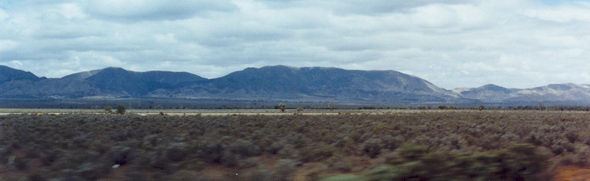
Researchers find canyons helped preserve some of ’s earliest complex life.
About 550 million years ago, the lay beneath the ocean. Researchers found evidence that ancient sea-level changes formed underwater canyons there and helped preserve early complex life.
The canyons were found across the Flinders Ranges and reached up to 280 metres deep and 6 kilometres wide.
As the canyons filled and sea levels rose, a shallow shelf suitable for microbial mats developed; said the biota began growing there.
The story so far 2
- You’ve just read thisResearchers find Flinders Ranges canyons helped preserve some of Earth’s earliest complex life.
- A study finds 280-meter-deep underwater canyons helped preserve South Australia’s Ediacaran fossils.
Sources 1
- AOcean that once covered Flinders Ranges preserved Earth's earliest lifeSun 15 Nov, 7:36am↗
ABC News - Victoria Top Stories
- A
The findings suggest that flooding of seawater played a crucial part in the formation of the canyons, and subsequently the preservation of some of the first complex life on the planet
↗ - A
The findings focused on the Ediacaran period, about 550 million years ago
↗ - A
You have to imagine that the Flinders Ranges … was under the ocean," University of Adelaide associate professor Diego Garcia-Bellido said
↗ - A
The findings suggest that flooding of seawater played a crucial part in the formation of the canyons
↗
- A
Looking at Nilpena Ediacara National Park in the Flinders Ranges, researchers noticed unusual rock formations that indicated the presence of submarine canyons
↗ - A
Dr Garcia-Bellido and his colleagues from the university and the South Australian Museum began finding the canyons "all over the Flinders", up to 280 metres deep and 6 kilometres wide
↗ - A
up to 280 metres deep
↗ - A
6 kilometres wide
↗
- A
What we see is that, as the canyons get filled and the sea level rises, this creates in the shallow shelf an environment that is ideal for the shallow water microbial mat to grow
↗ - A
This is where this original Ediacara biota began to grow and actually produce the most diverse assemblage of this pre-animal world
↗
The Flinders Ranges are the largest mountain ranges in South Australia, which starts about 200 km (125 mi) north of Adelaide. The ranges stretch for over 430 km (265 mi) from Port Pirie to Lake Callabonna.
Earth is the third planet from the Sun and the only astronomical object known to harbor life. This is made possible by Earth being an ocean world, the only one in the Solar System sustaining liquid surface water. Almost all of Earth's water is contained in its ocean, which covers 70.8% of Earth's crust. The remaining 29.2% of Earth's crust is dry land, which is predominantly located within Earth's land hemisphere in the form of continental landmasses. Most of Earth's land is at least somewhat humid and covered by vegetation, while large ice sheets at Earth's polar deserts retain more water than Earth's groundwater, lakes, rivers, and atmospheric water combined. Earth's crust consists of slowly moving tectonic plates, which interact to produce mountain ranges, volcanoes, and earthquakes. Earth has a liquid outer core that generates a magnetosphere capable of deflecting most of the destructive solar wind and cosmic radiation.
The Ediacaran is a geological period of the Neoproterozoic Era that spans 96 million years from the end of the Cryogenian Period 635 million years ago to the beginning of the Cambrian Period 538.8 million years ago. It is the last period of the Proterozoic Eon as well as the last of the so-called "Precambrian supereon", before the beginning of the subsequent Cambrian Period marks the start of the Phanerozoic Eon, where recognizable fossil evidence of life becomes common.