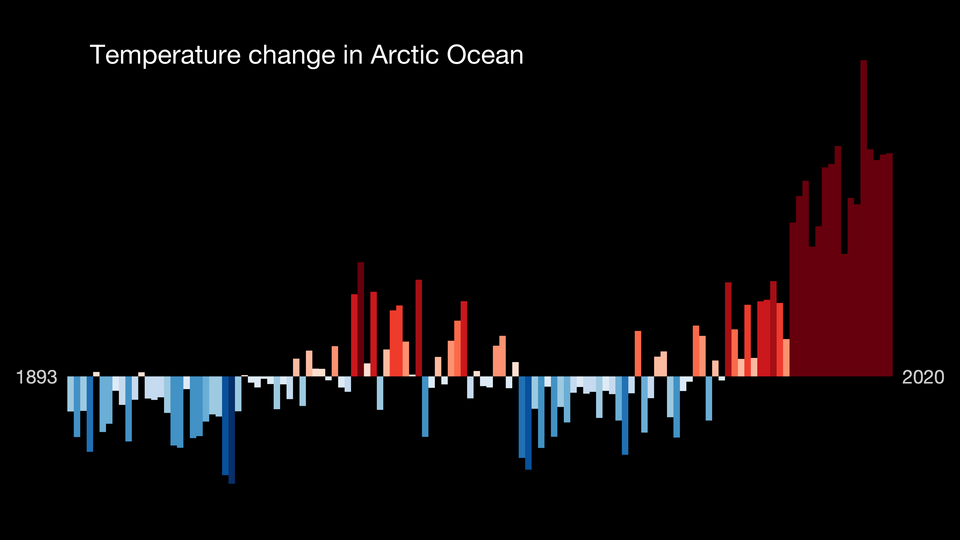
Study identifies low Arctic winter sea ice as an early clue to Eurasian summer drought.
A winter with much less sea ice than usual in the Barents and Kara Seas may signal greater drought risk the following summer across a corridor from eastern , and to western . The study found evidence of a directional link between reduced winter ice and increased summer drought.
The drought followed scarce rain and repeated heatwaves, and was described as one of the most severe in history since 1540. Wildfires occurred across western Europe, while eastern Europe was also heavily affected.
After winters with less sea ice, researchers found a bendier pattern in the atmosphere over the North Atlantic and , which can bring warm, dry air into the drought corridor and cause stagnant weather.
Sources 1
- M
miragenews.com
stretching from eastern Romania, Moldova and Ukraine, across the northern Black Sea and Caspian regions, into western Kazakhstan
↗ - M
If we have a winter with much less sea ice than usual, we have an early clue that drought is more likely in these regions the following summer
↗
- M
This summer, with its scarce rainfall and repeated heatwaves, witnessed one of the most severe droughts in European history since 1540
↗ - M
one of the most severe droughts in European history since 1540
↗ - M
The resulting wildfires across western Europe received considerable media attention
↗ - M
but eastern Europe was also heavily hit
↗
- M
In our data, winters with less sea ice in the Barents and Kara Seas were followed by a bendier pattern over the North Atlantic and Eurasia
↗ - M
Such a bendy atmospheric circulation pattern can bring relatively warm, dry air into our newly identified drought corridor in Eurasia and lead to stagnant weather
↗
About
Eurasia, is the largest continental area on Earth, comprising all of Europe and Asia. According to some models of the world, physio-graphically, Eurasia is a single continent. The concept of Europe and Asia as distinct continents dates back to antiquity, and is largely cultural, but their borders have historically been subject to change. For example, the ancient Greeks originally included Africa in Asia but classified Europe as separate land. Eurasia is connected to Africa at the Suez Canal, and the two are sometimes combined to describe the largest contiguous landmass on Earth, Afro-Eurasia.
About
Europe is a continent located entirely in the Northern Hemisphere and mostly in the Eastern Hemisphere. It is bordered by the Arctic Ocean to the north, the Atlantic Ocean to the west, the Mediterranean Sea to the south, and Asia to the east. Europe shares the landmass of Eurasia with Asia, and of Afro-Eurasia with both Africa and Asia. Europe is commonly considered to be separated from Asia by the watershed of the Ural Mountains, the Ural River, the Caspian Sea, the Greater Caucasus, the Black Sea, and the Turkish straits.
About
Kazakhstan, officially the Republic of Kazakhstan, is a landlocked country situated primarily in Central Asia, with a portion of its territory extending into Eastern Europe. It borders Russia to the north and west, China to the east, Kyrgyzstan to the southeast, Uzbekistan to the south, and Turkmenistan to the southwest, and it has a coastline along the Caspian Sea. The capital is Astana, and the country's largest city and principal cultural and economic center is Almaty, which served as the capital until 1997.
About
Moldova, officially the Republic of Moldova, is a landlocked country in Eastern Europe, with an area of 33,843 km2 (13,067 sq mi) and a population of 2.38 million. Moldova is bordered by Romania to the west and Ukraine to the north, east, and south. The unrecognised breakaway state of Transnistria lies across the Dniester river on the country's eastern border with Ukraine. Moldova is a parliamentary democratic republic with its capital in Chișinău, the country's largest city and main cultural and commercial centre.
About
Romania is a country in Central and Southeastern Europe. It lies on the lower course of the Danube, north of the Balkan Peninsula, and on the northwestern shore of the Black Sea. It borders Ukraine to the north and east, Hungary to the west, Serbia to the southwest, Bulgaria to the south, Moldova to the east, and the Black Sea to the southeast. It is the twelfth-largest country in Europe by area, covering 238,397 km2 (92,046 mi2), and the sixth-most populous member state of the European Union, with 19 million inhabitants. The capital, largest city and economic centre is Bucharest. Other major cities include Cluj-Napoca, Iași, Constanța, Timișoara, Brașov and Craiova.
The US, Russian and Chinese leaders issued a peace declaration at their first trilateral summit that omitted mention of the wars in Ukraine and Iran.
Ukraine critically damaged the Kerch Bridge linking Russia and occupied Crimea in an overnight missile attack.→ 22 NovAbout
Ukraine is a country in Eastern Europe. It is the second-largest country in Europe after Russia, which borders it to the east and northeast. Ukraine also borders Belarus to the north; Poland and Slovakia to the west; Hungary, Romania and Moldova to the southwest; and the Black Sea and the Sea of Azov to the south and southeast. Kyiv is Ukraine's capital and largest city, followed by Kharkiv, Odesa, and Dnipro. The official language is Ukrainian. Ukraine covers about 603,628 km2 (230,000 sq mi), with around 32 million people.