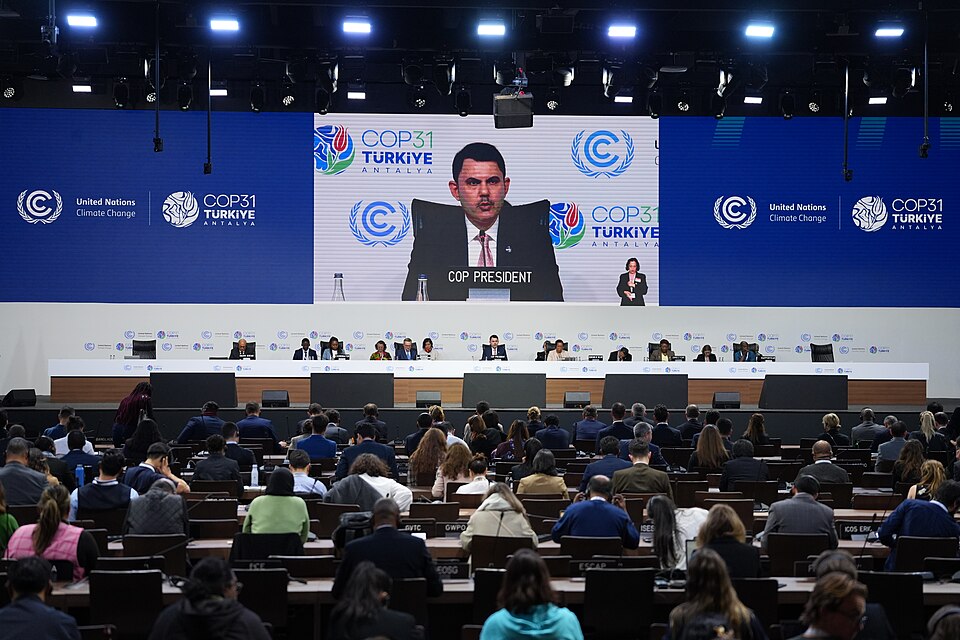
Pope Leo calls UN talks failure troubling, first failed deal since 2009.
criticised the failed climate talks at a public address in St Peter’s Square on Wednesday, saying world leaders should do more to address climate change.
The talks collapsed on Sunday after the and others rejected a proposed deal from and , saying it was too weak. The last time the talks failed to adopt a deal was after the 2009 summit.
Leo called for countries to take more shared responsibility and make major changes to how societies and economies operate.
Sources 2
- P
perthnow.com.au
Pope Leo XIV has sharply criticised the failure of UN climate talks over the weekend, calling the outcome "troubling" and urging world leaders to step up efforts to combat climate change … the Pope told pilgrims at his weekly audience in St Peter's Square on Wednesday
↗ - A
AAP News
Pope Leo XIV has sharply criticised the failure of UN climate talks over the weekend, calling the outcome "troubling" and urging world leaders to step up efforts to combat climate change … the Pope told pilgrims at his weekly audience in St Peter's Square on Wednesday
↗
- P
The COP31 talks collapsed on Sunday … the European Union and others rejected a final deal put forward by COP31 presidents Turkey and Australia … saying it was too weak to advance the fight against global warming … The last time UN climate talks failed to get a deal adopted was after a summit in Copenhagen in 2009
↗ - A
The COP31 talks collapsed on Sunday … the European Union and others rejected a final deal put forward by COP31 presidents Turkey and Australia … saying it was too weak to advance the fight against global warming … The last time UN climate talks failed to get a deal adopted was after a summit in Copenhagen in 2009
↗
- P
This situation calls for a renewed sense of shared responsibility, new forms of solidarity among nations and fundamental changes in behaviours, socio-economic systems, and the governance of our societies
↗ - A
This situation calls for a renewed sense of shared responsibility, new forms of solidarity among nations and fundamental changes in behaviours, socio-economic systems, and the governance of our societies
↗
About
Australia, officially the Commonwealth of Australia, is a country comprising the mainland of the Australian continent, the island of Tasmania and numerous smaller islands. It has a land area of 7,688,287 km2 (2,968,464 sq mi), making it the sixth-largest country in the world, and is the world's flattest and driest inhabited continent. It is a megadiverse country, and its size gives it a wide variety of landscapes and climates, including large deserts centrally and tropical rainforests along the coast.
About
Copenhagen is the capital and most populous city of Denmark, with an urban population of 1.4 million. The city is situated mainly on the island of Zealand (Sjælland), with a smaller part on the island of Amager. Copenhagen is separated from Malmö, Sweden, by the Øresund strait. The Øresund Bridge connects the two cities by rail and road.
About
The European Union (EU) is a political and economic union of 27 member states that are located primarily in Europe. A supranational union with a total area of 4,233,255 km2 (1,634,469 sq mi) and an estimated population of just under 452 million as of 2026, its member states generated a nominal gross domestic product (GDP) of around €18.802 trillion in 2025, accounting for approximately one sixth of global economic output. The EU is often described as a sui generis political entity combining characteristics of both a federation and a confederation.
About
Pope Leo XIV is the head of the Catholic Church and sovereign of Vatican City.
About
Turkey, officially the Republic of Türkiye, is a country mainly located in Anatolia in West Asia, with a smaller part called East Thrace in Southeast Europe. It borders the Black Sea to the north; Georgia, Armenia, Azerbaijan, and Iran to the east; Iraq, Syria, and the Mediterranean Sea to the south; and the Aegean Sea, Greece, and Bulgaria to the west. Turkey is home to over 86 million people; most are ethnic Turks, while Kurds are the largest ethnic minority. Officially a secular state, Turkey has a Muslim-majority population. Ankara is Turkey's capital and second-largest city. Istanbul is its largest city and economic center. Other major cities include İzmir, Bursa, and Antalya.
About
The United Nations (UN) is an international intergovernmental organization established by the signing of the Charter of the United Nations on 26 June 1945 with the articulated mission of maintaining international peace and security, developing friendly relations among states, promoting international cooperation, and serving as a center for harmonizing the actions of states in achieving those goals. With 193 member states, the UN is the largest international organization in the world.
More on Turkey