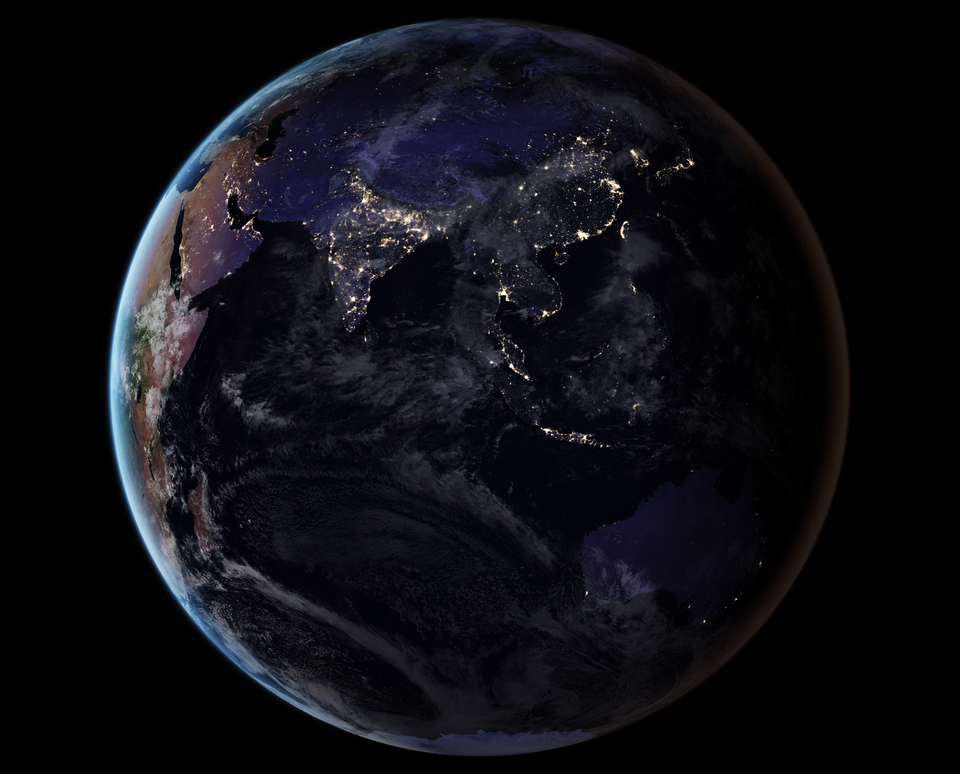
has captured a 3-foot space rock as a temporary mini-moon.
’s gravity pulled the space rock into orbit in April, after it crossed the boundary where objects can remain bound to Earth despite the ’s influence.
Astronomers first thought it might be rocket or satellite debris, but follow-up observations showed it was natural; the Minor Planet Center declared it a temporary mini-moon.
It is expected to leave Earth’s gravitational grasp by December and continue orbiting the Sun. It poses no collision risk.
Sources 1
Earth is the third planet from the Sun and the only astronomical object known to harbor life. This is made possible by Earth being an ocean world, the only one in the Solar System sustaining liquid surface water. Almost all of Earth's water is contained in its ocean, which covers 70.8% of Earth's crust. The remaining 29.2% of Earth's crust is dry land, which is predominantly located within Earth's land hemisphere in the form of continental landmasses. Most of Earth's land is at least somewhat humid and covered by vegetation, while large ice sheets at Earth's polar deserts retain more water than Earth's groundwater, lakes, rivers, and atmospheric water combined. Earth's crust consists of slowly moving tectonic plates, which interact to produce mountain ranges, volcanoes, and earthquakes. Earth has a liquid outer core that generates a magnetosphere capable of deflecting most of the destructive solar wind and cosmic radiation.
The Sun is the star located at the centre of the Solar System. It is a massive sphere of hot plasma, heated to incandescence by nuclear fusion reactions in its core, radiating the energy from its surface mainly as visible light and infrared radiation, with 10% at ultraviolet energies. It is the main source of energy for life on Earth. The Sun has been an object of veneration in many cultures and a central subject of astronomical research since antiquity.