Researchers identify 29 deposits that may be ancient glaciers, with cliffs up to 209 meters.
The researchers examined 738 craters to find the 29 deposits, using satellite images to build 3D maps and computer modeling to interpret them.
The deposits lie inside impact craters around Alba Mons in ’s northern hemisphere; researchers interpret them as ice covered by rocks, dust and other debris.
The formations may preserve clues to a colder period in Mars’s past and help researchers understand when this area was last covered in ice.
Sources 1
- YScientists Have Discovered Strange Glaciers With Towering Cliffs Inside Martian CratersWed 18 Nov, 1:00am↗
Yahoo News Content : ScienceAlert : The Best in Science News and Amazing Breakthroughs
- Y
If the steep escarpments – 29 in all – do turn out to be glaciers
↗ - Y
A total of 738 craters were examined
↗ - Y
Computer modeling was then used to figure out how these glaciers may have formed, and how the geology should be interpreted
↗
- Y
that's what the study team believes has been spotted here, around the Alba Mons volcano in the northern hemisphere of the planet
↗ - Y
We report the occurrence of lobate, pole-facing, steep-fronted ice-rich deposits within kilometer-scale fresh impact craters in the Alba Mons region
↗ - Y
we're looking at 29 deposits of glacier ice, currently covered by rocks, dust, and other debris
↗
- Y
They possibly formed during a relatively recent colder period on Mars
↗ - Y
and preserved under favorable topographic conditions on pole-facing crater slopes
↗ - Y
these newly discovered formation types might also be useful in working out when this part of Mars was most recently covered in ice
↗
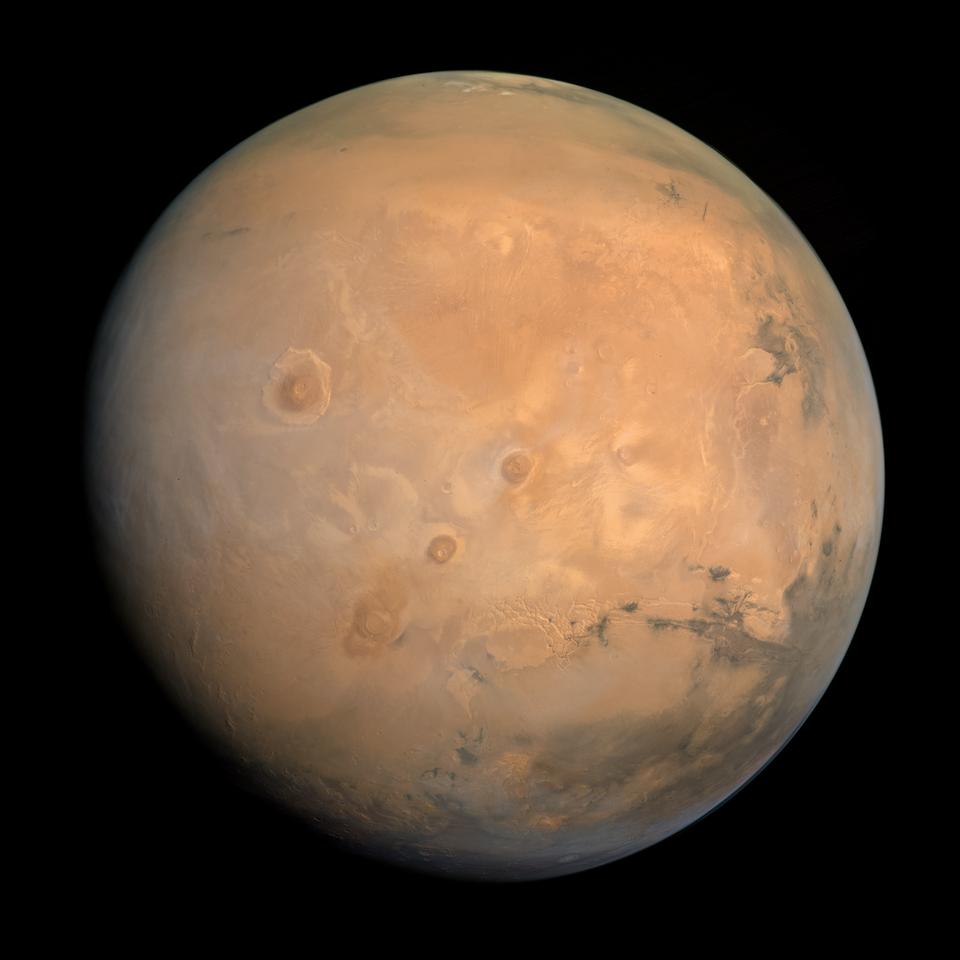
Mars is the fourth planet from the Sun. It is also known as the "Red Planet", for its orange-red appearance. Mars is a desert-like rocky planet with a tenuous atmosphere that is primarily carbon dioxide. At the average surface level the atmospheric pressure is a few thousandths of Earth's, atmospheric temperature ranges from −153 to 20 °C, and cosmic radiation is high. Mars retains some water, in the ground as well as thinly in the atmosphere, forming cirrus clouds, fog, frost, larger polar regions of permafrost and ice caps, but no bodies of liquid surface water. Its surface gravity is roughly a third of Earth's or double that of the Moon. Its mean diameter, 6,779 km (4,212 mi), is about half the Earth's, or twice the Moon's, and its surface area is around the size of all the dry land of Earth.