arXiv
Every Brief story that names arXiv, gathered from the outlets that covered it.
- Stories100
Every story
All arXiv news100
Every story that names arXiv, newest first.
A study finds stable recursive training of code LLMs requires exogenous verification.
Researchers introduce LR-Guard as an LLM safety guardrail that delivers 19.4x inference speedup.
A study runs the first controlled adversarial comparison of AI safety judges.
James Fitzgerald unveils DPMS to enable unified modeling of whole-brain neural activity across individual subjects.
An AI verification framework helps resolve three Langlands open conjectures.
arXiv paper reports new multi-agent deferred-decision controller captures 79% of targets under strict control-effort budget.
A research paper introduces a benchmark whose average full pass rate is below 1%.
Audit finds HELM Safety's HarmBench does not measure a singular attribute.
Researchers publish TRACE, the first quantitative framework to operationalise EU AI Act Article 13 compliance.
Researchers publish RH-Detect, a benchmark pooling 92,761 rows that reveals lower accuracy on multi-turn tool-use datasets.
US export controls suspend two frontier models over a jailbreak that asked a model to read code.
Paper shows a perfect AI cannot guarantee safe behaviour in some time-limited, partially observed scenarios.
Show 85 older stories
October 2026arXiv paper finds agents comply with harmful goals when given as decomposed variants.
The largest synthesis finds teacher wellbeing linked to student motivation and achievement.
New research finds 13 LLM safety judges broadly resist updating judgments when context or definitions change.
Researchers propose AgentPrivArena and AgentPrivAudit to expose substantial privacy risks in LLM agents.
September 2026Tokenizer settings leave 255 of 400 popular chat models exposed to prompt-injection exploits.
arXiv publishes CIFAR evidence benchmark of 1,505 images and finds detectors still unreliable for courts.
Darebin City Council announces return of Get Active in Darebin Spring Program.
AI deepfakes are appearing as paid ads ahead of Victoria's state election, confusing voters.
Researchers show activation steering can make language models resist shutdown, complicating 'kill switch' plans.
Ultimo development records its second incident in weeks after scaffolding falls onto cars.
New arXiv research delivers practical tools to audit and defend black-box AI systems.
Shadow education minister’s plan could narrow Indigenous teaching and sideline the 1886 Aborigines Protection Act.
A new model named ACE learns six daily activity‑personas from London phone location data.
AI-trained graph neural network picks vehicle relays in real time, cutting decision time by 100x.
Researchers introduce PaGNet hybrid model to forecast corporate tax-avoidance proxies.
Researchers build a federated violence‑detection model that keeps video on devices using FedVideoMAE.
New ML method finds better trading peers using 5,631 US stocks.
Platforms can stop hidden AI data leaks with PAPC.
New arXiv paper introduces PhysCoRe to improve robot handling of deformable objects.
LLM system converts discharge notes into date-grouped mental-health timelines, tagging 15,891.
Study: behavioral cues flag when people switch subtasks with an AI partner.
A new hybrid model called KAINN predicts farm nitrous-oxide emissions more accurately.
Digital Green's FarmerChat cuts speech-recognition errors up to 42% with a modular pipeline.
Researchers build a shared match graph to make soccer highlights searchable with SportSAGE.
New benchmark dataset aims to train AI on biophysics with 500 cases.
A new additive profile gives Croissant clear, fast rules to decide dataset refusals.
ArXiv paper shows chunking and embeddings reshape chemistry retrieval using ChemQuests.
New multimodal system turns 52,949 PubMed case reports into searchable clinical summaries.
Paper on arXiv shows 11.2M-parameter classifier extracts geo-mining data in minutes.
Researchers publish open-source method DeltaSelect to speed development checks on coding-agent benchmarks.
New arXiv paper describes AI that claims to autonomously produce publishable scientific papers and code.
Researchers introduce TripScore to align LLMs with real-world travel planning.
Study finds prewritten plans lift success by 7.17 percentage points in agent tests.
A new embedding metric, SCF, predicts slower processing and bigger neural changes.
New deep-learning model HyperAMS‑Net claims top accuracy on three brain‑disorder MRI benchmarks.
New arXiv paper argues policy-vote bagging can cut sampling risk in policy learning.
Visual attractiveness shapes buying choices, and websites form opinions in 50 milliseconds.
Paper warns AI advisers can push harmful updates to quantum error correction.
New streaming method cuts video bandwidth by 99.9% using skeletal metadata and client rendering.
New paper argues sex for AI by applying population genetics to multigenerational models.
Study finds gradient-boosted trees still competitive on EHR benchmarks across two datasets.
Researchers say they can infer shoppers' deep values from Taobao behavior, improving accuracy by 34%.
Paper says internal audits of agentic AI spot just 5.9% of detectable faults.
Therapist recounts client who sold everything during March 2020 market crash to teach investing emotions.
Two new AI studies say symbolic rules boost results to 98.2% and improve foresight.
Fixing test overlap wipes out NIR camera advantage for daylight farm vehicles.
Researchers outline rules to safely delegate oversight to misaligned AI reviewers.
Researchers say new AI agent training method boosts performance 10.6% across benchmarks.
An arXiv preprint unveils a public-data startup toolkit, scores 0.6506, and releases auditable EventChain data.
New AI links mental-health surveys across institutions while cutting client compute 1,000×.
NeuroProlog turns math word problems into verifiable Prolog programs.
arXiv paper unveils no-ground-truth test that raises human–twin survey correlation 15%.
ClimateAgent completes 100% of 85 climate analysis tasks on new arXiv benchmark.
Researchers extend a self-motivation metric to AI groups, showing organized behavior in pairs and flocks.
A new AI algorithm beat its predecessor in 25 of 33 tests.
Researchers propose five-layer system to enforce AI policy in real time.
AI judges and human readers disagree on whether 'reasoning' makes stories deeper.
AI framework CLEAR lifts app benchmark success to 81.15% by learning from past runs.
New arXiv paper proposes Generalized Agent Iteration to unify recursive self-improvement and policy iteration.
A simple baseline beat AI 'farmer' agents, revealing the average-farmer illusion.
Colorado State study says turning off irrigation would cause 363 times more emissions than irrigating.
MIT debuts HardFlow, making generative AI follow strict safety constraints without retraining.
New arXiv studies find generative AI boosts ad personalization, but overdoing it spooks consumers.
7T brain scans help machine learning identify advanced meditation states with 66.82% accuracy.
Researchers map seven land-use clusters across 100 European urban areas.
Feeding full biological paths helps AI reason from evidence in 13,200 hypotheses.
New study maps how AI agents get jailbroken and why today's defenses fall short.
Researchers unveil a detector for malicious intent in 6G networks, hitting 97% accuracy.
Averaging across episodes improves one-shot sensor fault diagnosis in industrial tests.
The CIVIC-AI Collaboration sets six conditions for AI that augments human work.
New AI tool spots social tipping point evidence in climate papers.
Expert audit finds physics AI benchmarks understate performance, showing near-saturation after corrections.
New AI framework analyzes body-camera footage to map how Rochester police and civilians interact.
Researchers turn Harvard Dataverse into a 215,985-node map linking datasets, places and publications.
New benchmark finds AI agents solve only 43.1% of long‑horizon research tasks.
Researchers find AI models hide more mental-health stigma in their reasoning than answers show.
New physics test finds AI agents mishandle one in three household hazards.
New generator builds entire fake companies across 66 business systems and scores near-perfect realism.
Study finds LLMs rank medical models better than they explain them, need oversight.
Researchers say Veilmind-4B pipeline lowers privacy leaks while preserving LLM utility.
New two-layer system aims to stop poisoned logs from hijacking AI in security centers.
Researchers post ARCHE on arXiv, an AI system that automates reaction mechanism discovery.
AI soccer analysis tool helps complete 33 of 48 tasks in tests.
Researchers introduce data stories to explore and assess cultural-heritage knowledge graphs.
A new AI training layer reports a 100% step safety rate for step-by-step actions.
About
About arXiv
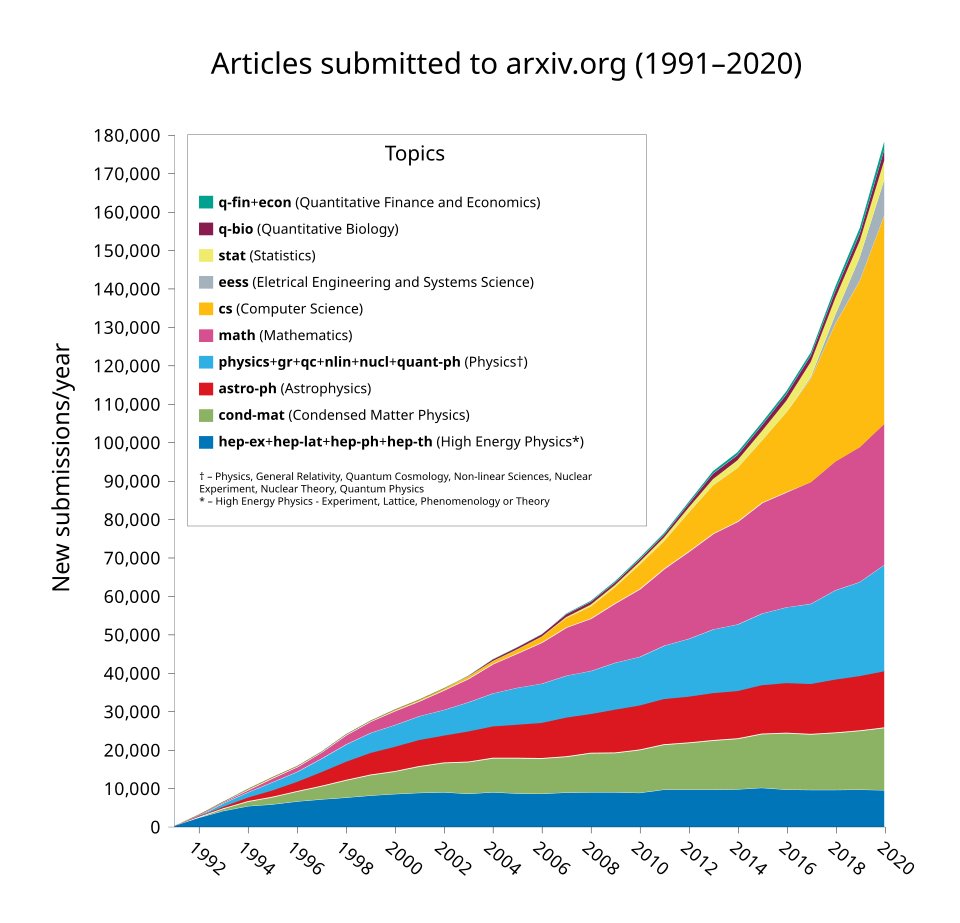
arXiv is an independent, open-access repository of electronic preprints and postprints approved for posting after moderation, but not peer reviewed. It consists of scientific papers in the fields of mathematics, physics, astronomy, electrical engineering, computer science, quantitative biology, statistics, mathematical finance, and economics, which can be accessed online. In many fields of mathematics and physics, almost all scientific papers are self-archived on the arXiv repository before publication in a peer-reviewed journal. Some publishers also grant permission for authors to archive the peer-reviewed postprint. Begun on August 14, 1991, arxiv.org passed the half-million-article milestone on October 3, 2008. By the end of 2014, it had surpassed one million articles, and it reached two million by the end of 2021. As of October 2026, the submission rate is about 32,000 articles per month.
Read more on Wikipedia ↗