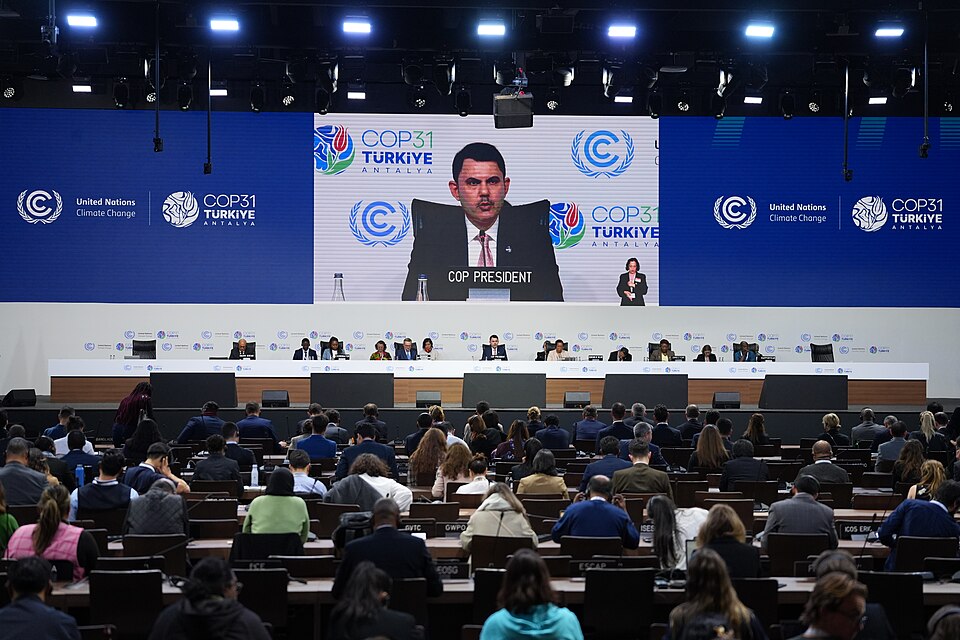
climate summit fails to agree a final deal for first time since 2009.
The annual climate summit known as COP31 ended on Sunday without a final deal. and had proposed one, but the , several island states and others rejected it as too weak.
It was the first time since 2009 that countries at the summit failed to reach a political agreement.
Negotiators said was chiefly responsible for the failure, resisting language about reducing reliance on fossil fuels.
The story so far 5
OngoingCOP31 Climate Talks- A UN climate-rights chief and First Nations woman challenge Australia’s coal and gas approvals at COP31.
- The UN climate chief says an ambitious COP31 outcome remains possible.
- Coalition urges Bowen to quit over COP31’s first climate deal failure in 17 years.
- You’ve just read thisUN climate summit fails to agree a final deal for first time since 2009.
- UN climate summit ends without a final decision for the first time since 2009.
Sources 2
- P
perthnow.com.au
The UN climate talks ended in collapse on Sunday … the European Union, several small island states and others rejected a final deal put forward by COP31 presidents Turkey and Australia, saying it was too weak to advance the fight against global warming
↗ - A
AAP News
The UN climate talks ended in collapse on Sunday … the European Union, several small island states and others rejected a final deal put forward by COP31 presidents Turkey and Australia, saying it was too weak to advance the fight against global warming
↗
- P
Saudi Arabia was at the forefront of resisting language on reducing reliance on fossil fuels, the negotiators said … adding that was chiefly why a political agreement could not be reached for the first time since 2009
↗ - A
Saudi Arabia was at the forefront of resisting language on reducing reliance on fossil fuels, the negotiators said … adding that was chiefly why a political agreement could not be reached for the first time since 2009
↗
The United Nations (UN) is an international intergovernmental organization established by the signing of the Charter of the United Nations on 26 June 1945 with the articulated mission of maintaining international peace and security, developing friendly relations among states, promoting international cooperation, and serving as a center for harmonizing the actions of states in achieving those goals. With 193 member states, the UN is the largest international organization in the world.
Turkey, officially the Republic of Türkiye, is a country mainly located in Anatolia in West Asia, with a smaller part called East Thrace in Southeast Europe. It borders the Black Sea to the north; Georgia, Armenia, Azerbaijan, and Iran to the east; Iraq, Syria, and the Mediterranean Sea to the south; and the Aegean Sea, Greece, and Bulgaria to the west. Turkey is home to over 86 million people; most are ethnic Turks, while Kurds are the largest ethnic minority. Officially a secular state, Turkey has a Muslim-majority population. Ankara is Turkey's capital and second-largest city. Istanbul is its largest city and economic center. Other major cities include İzmir, Bursa, and Antalya.
Australia, officially the Commonwealth of Australia, is a country comprising the mainland of the Australian continent, the island of Tasmania and numerous smaller islands. It has a land area of 7,688,287 km2 (2,968,464 sq mi), making it the sixth-largest country in the world, and is the world's flattest and driest inhabited continent. It is a megadiverse country, and its size gives it a wide variety of landscapes and climates, including large deserts centrally and tropical rainforests along the coast.
The European Union (EU) is a political and economic union of 27 member states that are located primarily in Europe. A supranational union with a total area of 4,233,255 km2 (1,634,469 sq mi) and an estimated population of just under 452 million as of 2026, its member states generated a nominal gross domestic product (GDP) of around €18.802 trillion in 2025, accounting for approximately one sixth of global economic output. The EU is often described as a sui generis political entity combining characteristics of both a federation and a confederation.
Saudi Arabia, officially the Kingdom of Saudi Arabia (KSA), is a country in West Asia that occupies the bulk of the Arabian Peninsula. Covering a land area of approximately 2,149,690 km2 (830,000 sq mi), it is the fifth-largest country in Asia and the twelfth-largest in the world. It is bordered by the Red Sea to the west, Jordan, Iraq, and Kuwait to the north, the Persian Gulf, Bahrain, Qatar, and the United Arab Emirates to the east, Oman to the southeast, and Yemen to the south. The Gulf of Aqaba in the northwest separates it from Egypt and Israel. Riyadh is the capital and largest city, while other major centers include Jeddah and the two holiest cities in Islam, Mecca and Medina.
More on People's Republic of China · Saudi Arabia · Turkey · Canada