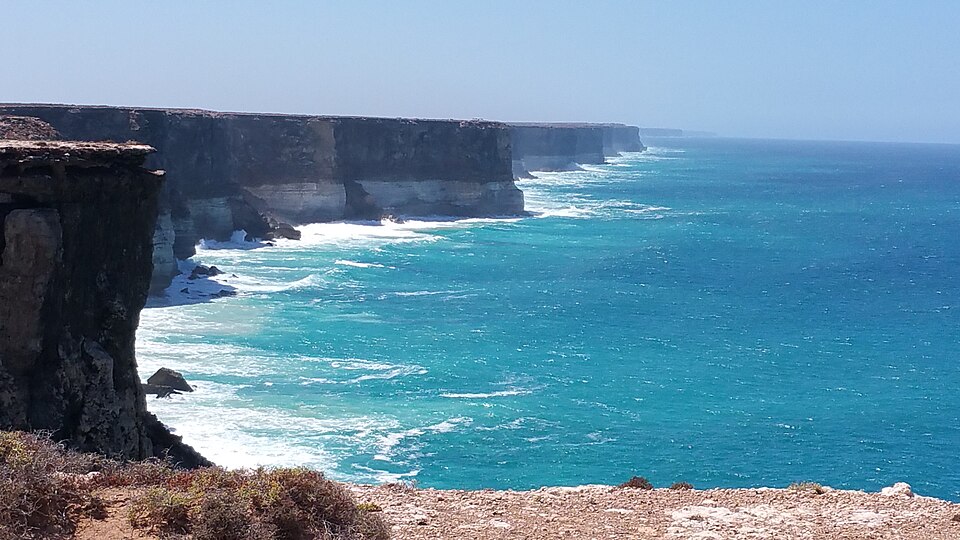
Shallow trenches on the Nullarbor point to vast hidden caves and could guide Mars life searches.
The team says the trenches are produced when underground caves gradually collapse, and the deepest collapse reached 9 metres below the surface.
Researchers say shallow surface trenches on the Nullarbor map the footprint of much deeper cave systems, even though the trenches are only a couple of metres deep.
Some trenches measure up to 20km long and can be hundreds of metres wide, despite their minimal depth at the surface.
The features are hard to see on the ground, so the team relied on satellite modelling and aerial photography to reveal the patterns across the Plain.
Scientists note karst cave systems offer stable, radiation‑shielded environments, so the Nullarbor findings could be used to search similar features on for signs of life.
The research builds on decades of fieldwork with speleologist Steve Milner and points to global applications for groundwater mapping and planetary exploration.
Sources 2
- ANew mapping reveals true size of hidden desert cavesFri 2 Oct, 6:00am↗
AAP News
- ANullarbor caves might hold secrets about life on Mars, research suggestsMon 28 Sept, 6:03am↗
ABC News - Victoria Top Stories
About
Mars is the fourth planet from the Sun. It is also known as the "Red Planet", for its orange-red appearance. Mars is a desert-like rocky planet with a tenuous atmosphere that is primarily carbon dioxide. At the average surface level the atmospheric pressure is a few thousandths of Earth's, atmospheric temperature ranges from −153 to 20 °C, and cosmic radiation is high. Mars retains some water, in the ground as well as thinly in the atmosphere, forming cirrus clouds, fog, frost, larger polar regions of permafrost and ice caps, but no bodies of liquid surface water. Its surface gravity is roughly a third of Earth's or double that of the Moon. Its mean diameter, 6,779 km (4,212 mi), is about half the Earth's, or twice the Moon's, and its surface area is around the size of all the dry land of Earth.