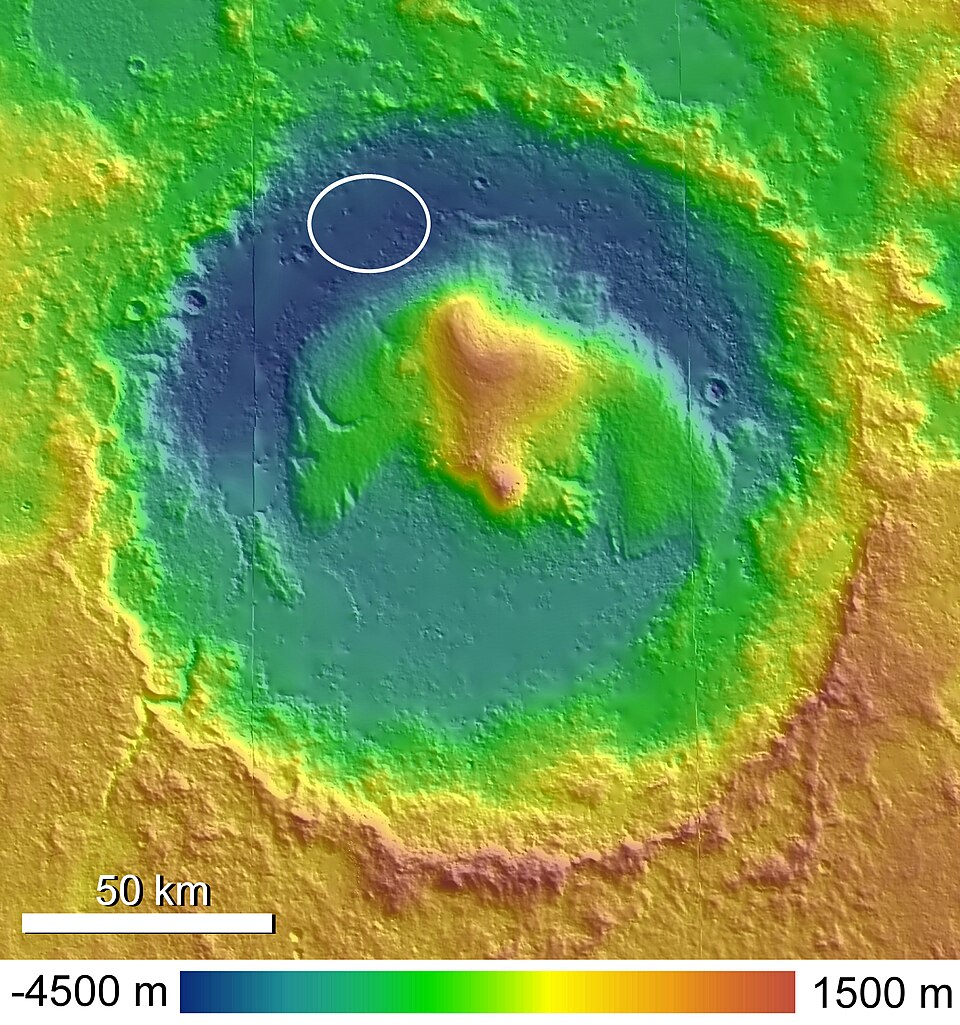
Researchers report indirect evidence of liquid-like water films on Mars today.
Curiosity’s data point to microscopic water films at Gale Crater that may interact with the atmosphere during the warmest part of the year.
The researchers analyzed atmospheric carbon dioxide measurements Curiosity gathered from 2012 to 2025, described as the first long-term record of its kind for Mars’s atmosphere.
Oxygen-18 increased in spring and summer, and only the explanation involving exchange between carbon dioxide and water reproduced the observed changes in the models.
The proposed films could be just several molecules thick and are not water bound in ice crystals.
Sources 1
- G
Gizmodo
they did find an increased proportion of oxygen-18 isotopes during the spring and summer seasons
↗ - G
The researchers used computer models to evaluate several possible explanations for this
↗ - G
but only one allowed them to reproduce the observed changes in oxygen-18 ratios
↗ - G
they believe atmospheric CO2 is exchanging oxygen isotopes with extremely thin, liquid-like films of water on the surface of the Gale Crater
↗
About
Mars is the fourth planet from the Sun. It is also known as the "Red Planet", for its orange-red appearance. Mars is a desert-like rocky planet with a tenuous atmosphere that is primarily carbon dioxide. At the average surface level the atmospheric pressure is a few thousandths of Earth's, atmospheric temperature ranges from −153 to 20 °C, and cosmic radiation is high. Mars retains some water, in the ground as well as thinly in the atmosphere, forming cirrus clouds, fog, frost, larger polar regions of permafrost and ice caps, but no bodies of liquid surface water. Its surface gravity is roughly a third of Earth's or double that of the Moon. Its mean diameter, 6,779 km (4,212 mi), is about half the Earth's, or twice the Moon's, and its surface area is around the size of all the dry land of Earth.