Researchers say future winter sea ice is likely to shrink by around one million square kilometres more than previously thought.
Scientists improved projections by comparing models to clues from a warm period 6,000 years ago, using ancient sea-ice signals to judge which models matched past conditions.
They compiled the largest-ever database of the biomarker IP25 from mid-Holocene ocean sediment cores to estimate past sea ice cover.
The team applied Bayesian weighting across 27 climate models, removing a historical positive bias and producing lower future winter sea ice estimates.
The revised projections suggest southeast snowfall and rainfall changes may be underestimated, with implications for ice-sheet stability and flood risk.
Lead author Crystal Fu warns that 'if it warms' — whether naturally or from humans — sea ice will respond by melting, and the results were published in Nature Geoscience.
Sources 2
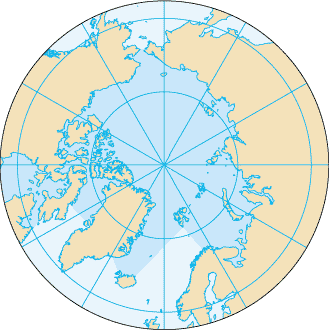
The Arctic is the polar region of Earth that surrounds the North Pole, lying north of the Arctic Circle. The Arctic region, from the IERS Reference Meridian travelling east, consists of parts of northern Norway, northernmost Sweden, northern Finland, Russia, the United States (Alaska), Canada, Danish Realm (Greenland), and northern Iceland, along with the Arctic Ocean and adjacent seas.
Greenland is an autonomous territory of the Kingdom of Denmark and is the largest of the kingdom's three constituent parts by land area, the others being Denmark proper and the Faroe Islands. Citizens of Greenland are citizens of Denmark. They are thus citizens of the European Union (EU), although Greenland is not part of the EU. It is the world's largest island and lies between the Arctic and Atlantic oceans, east of the Canadian Arctic Archipelago. It shares a small 1.2-kilometre (0.75 mi) border with Canada on Hans Island. The capital and largest city is Nuuk. Kaffeklubben Island off the northern coast is the world's northernmost undisputed point of land – Cape Morris Jesup on the main island was thought to be so until the 1960s. Economically, Greenland is heavily reliant on aid from Denmark, which has averaged 5.4 billion kr. annually in the period 2019–2023, amounting to more than 20% of the territory's gross domestic product.
A Mediterranean climate, also called a dry summer climate, described by Köppen and Trewartha as Cs, is a temperate climate type that occurs in the lower mid-latitudes. Such climates typically have dry summers and wet winters, with summer conditions being hot and winter conditions typically being mild. These weather conditions are typically experienced in the majority of Mediterranean-climate regions and countries, but remain highly dependent on proximity to the ocean, elevation, and geographical location.
More on United Kingdom