and publish open lunar to speed research.
and released a public Lunar Foundation model and companion dataset on . The dataset is the first unified, publicly available ML cache built for lunar research.
Trained on a huge, multimodal NASA dataset with over 30 layers from nine instruments across four missions, including tens of thousands of images and maps. It targets finding lunar ice, safe landing sites, and other geological features.
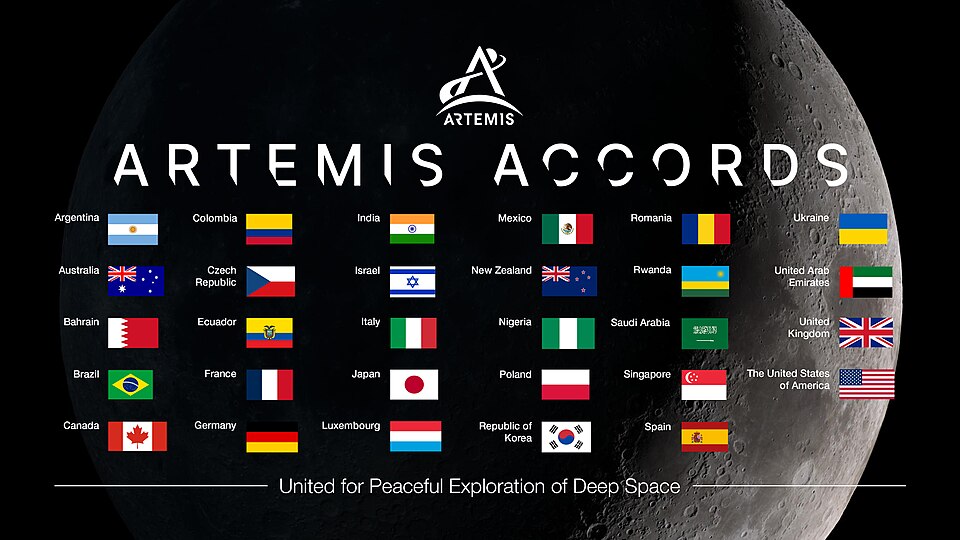
To expand open science under the Accords, NASA ran two virtual workshops from July 28 to Sept. 8. The accords now count 71 countries committed to transparent, interoperable data and tools.
NASA says the tools are publicly available now, inviting researchers and Artemis partners to build on them. Next up: continued alignment on data-sharing and potential input to landing-site picks for future missions.
Sources 2
The National Aeronautics and Space Administration is an independent agency of the U.S. federal government responsible for the United States' civil space program, as well as research in aeronautics and space. Headquartered in Washington, D.C., NASA operates ten field centers across the US and is organized into three mission directorates: Human Spaceflight, Research and Technology, and Science. Established in 1958 amid the Space Race, NASA succeeded the National Advisory Committee for Aeronautics (NACA) to give the US space program a distinct civilian orientation focused on peaceful applications. Since then, it has led most American spaceflight programs, including Project Mercury, Project Gemini, the Apollo program, Skylab, the Space Shuttle, the International Space Station (ISS), and the ongoing multinational Artemis program.
International Business Machines Corporation (IBM) is an American multinational technology company headquartered in Armonk, New York, and present in over 175 countries. It is a publicly traded company and one of the 30 companies in the Dow Jones Industrial Average. IBM is the largest industrial research organization in the world, with 19 research facilities across a dozen countries; for 29 consecutive years, from 1993 to 2021, it held the record for most annual U.S. patents generated by a business.
Artificial intelligence (AI) is the capability of computational systems to perform tasks typically associated with human intelligence, such as learning, reasoning, problem-solving, perception, and decision-making. It is also a field of research spanning computer science, engineering, and mathematics that develops and studies methods and software enabling machines to perceive their environment and use learning and intelligence to take actions that maximise their chances of achieving defined goals.
The Moon is the only natural satellite of Earth. It orbits Earth in an elliptical path, at a distance that varies over the year, averaging around 378,000 kilometers (235,000 mi). It completes an orbit in relation to Earth and the Sun (synodically) every 29.5 days. The Moon and Earth are bound by gravitational attraction, which is stronger on the sides facing each other. The resulting tidal forces are the main driver of Earth's tides, and have pulled the Moon to always face Earth with the same near side. This tidal locking effectively synchronizes the Moon's rotation period to its orbital period.
The Artemis program is a Moon exploration program led by the United States' National Aeronautics and Space Administration (NASA), aimed at returning humans to the Moon for the first time since the Apollo program and building a permanent Moonbase. It was formally established via Space Policy Directive-1 in 2017 by President Donald Trump. As of 2026, it has flown two successful missions, Artemis I and Artemis II, with three more planned through the end of 2028.
More on United Kingdom · Nvidia · Artificial intelligence · Republic of Ireland