Hubble Spots a 10-Sided Decagon Around Saturn's South Pole.
's has revealed a 10-sided decagon encircling 's south pole.
The structure extends through multiple atmospheric layers and emerged between 2023–2025, with earlier hints from ground observations.
Scientists say the southern decagon could be a new atmospheric phenomenon developing, unlike Saturn's north hexagon.
The study appears in Science Advances, underscoring the decagon's vertical footprint and evolving nature.
Sources 3
- MHubble Spots Decagon Around Saturn's South Pole↗
miragenews.com
- GA Giant Hexagon Has Been Spinning at Saturn’s North Pole for Decades. Now, Scientists Found Its TwinThu 3 Sept, 4:00am↗
Gizmodo
- YAstronomers Spot an Uncannily Geometric, 10-Sided Structure in Saturn's AtmosphereThu 3 Sept, 4:00am↗
Yahoo News Content : ScienceAlert : The Best in Science News and Amazing Breakthroughs
About
The National Aeronautics and Space Administration is an independent agency of the U.S. federal government responsible for the United States' civil space program, as well as research in aeronautics and space. Headquartered in Washington, D.C., NASA operates ten field centers across the US and is organized into three mission directorates: Human Spaceflight, Research and Technology, and Science. Established in 1958 amid the Space Race, NASA succeeded the National Advisory Committee for Aeronautics (NACA) to give the US space program a distinct civilian orientation focused on peaceful applications. Since then, it has led most American spaceflight programs, including Project Mercury, Project Gemini, the Apollo program, Skylab, the Space Shuttle, the International Space Station (ISS), and the ongoing multinational Artemis program.
About
Saturn is the sixth planet from the Sun, and is the second largest planet in the Solar System, after Jupiter. It is a gas giant, with an average radius of about 9 times that of Earth. It has an eighth of the average density of Earth, but is over 95 times more massive. Even though Saturn is almost as big as Jupiter, it has less than a third of its mass. Saturn orbits the Sun at a distance of 9.59 AU (1,434 million km), with an orbital period of 29.45 years.
About
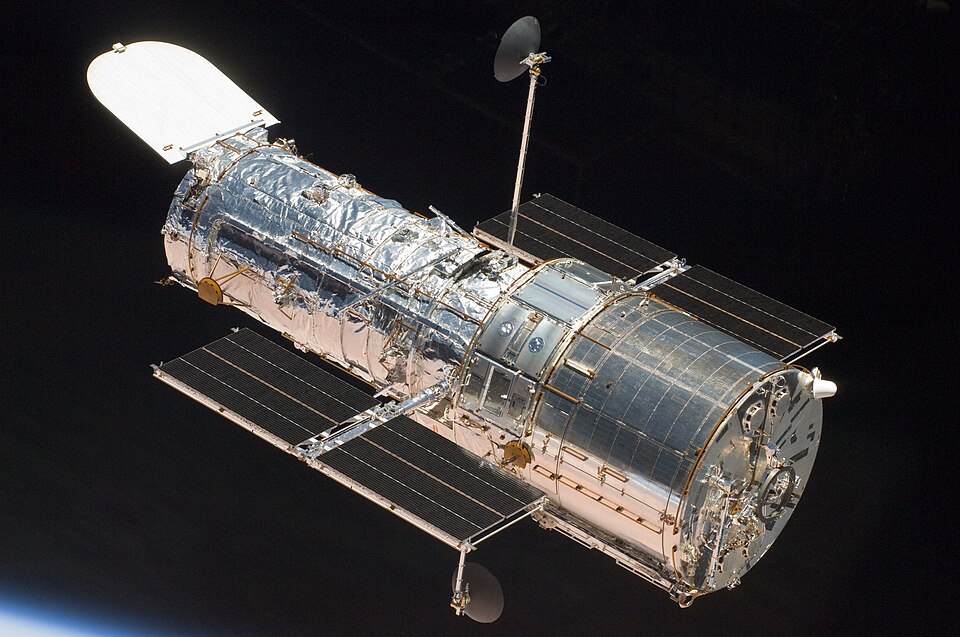
The Hubble Space Telescope is a space telescope that was launched into low Earth orbit in 1990 during the STS-31 and remains in operation. It is regarded as one of the largest and most versatile space telescopes, renowned as a vital research tool and as a public relations boon for astronomy. The Hubble Space Telescope is named after astronomer Edwin Hubble and is one of NASA's Great Observatories. The Space Telescope Science Institute (STScI) selects Hubble's targets and processes the resulting data, while the Goddard Space Flight Center (GSFC) controls the spacecraft.