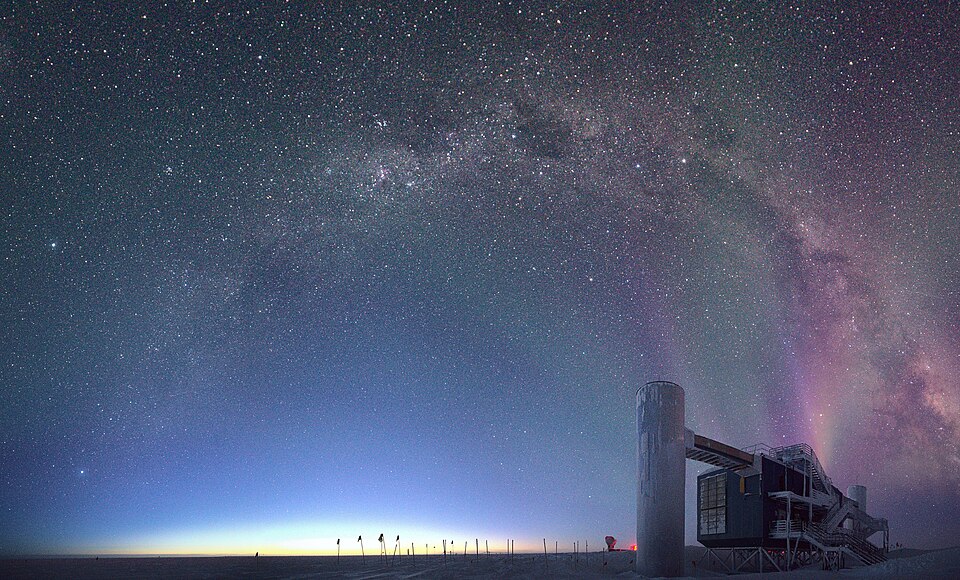
Francis Halzen wins the Nobel Prize for IceCube neutrino discoveries.
The 2026 physics prize recognized , a professor, for ’s discovery of high-energy neutrinos of astrophysical origin.
IceCube detected neutrinos created by some of the universe’s most distant and violent phenomena, beginning an era of neutrino astronomy.
The observatory uses more than 5,000 glass spheres buried across a cubic-kilometer grid beneath a mile of ice.
Sources 4
- MBerkeley Lab Helps Build Telescope Like No OtherThu 12 Nov, 11:00am↗
miragenews.com
- 7The Nobel Prize in Physics has been won for observing ghost-like particles in Antarctica. Belgian…Wed 7 Oct, 6:31am↗
7newsmelbourne
- ANobel Prize in Physics honours work on 'ghost messengers from space'Tue 6 Oct, 10:07pm↗
ABC News - Victoria Top Stories
- P'Ghost particle' hunter wins Nobel physics prizeTue 6 Oct, 5:59pm↗
perthnow.com.au
About
Francis Louis Halzen is a Belgian-American physicist who has worked in both theoretical and experimental particle physics, including high-energy astrophysics. Born in Belgium, he was educated at the Catholic University of Leuven and worked as a scientific associate at CERN before moving to the United States, where he has been a professor at the University of Wisconsin–Madison since 1972. Since 2001 he has been the principal investigator and co-spokesperson of the IceCube Neutrino Observatory, the world's largest neutrino detector, based at the Amundsen–Scott South Pole Station in Antarctica. He received the 2026 Nobel Prize in Physics "for decisive contributions to the IceCube Neutrino Observatory and the discovery of high-energy neutrinos of astrophysical origin."
About
Antarctica is Earth's southernmost and least-populated continent. Situated almost entirely south of the Antarctic Circle and surrounded by the Southern Ocean, it contains the geographic South Pole. Antarctica is the fifth-largest continent, being about 40% larger than Europe, and has an area of 14,200,000 km2 (5,500,000 sq mi). Most of Antarctica is covered by the Antarctic ice sheet, with an average thickness of 1.9 km (1.2 mi).
About
The IceCube Neutrino Observatory is a neutrino observatory developed by the University of Wisconsin–Madison and constructed at the Amundsen–Scott South Pole Station in Antarctica. The project is a recognized CERN experiment (RE10). Its thousands of sensors are located under the Antarctic ice in a glacier, distributed over a cubic kilometer.
A University of Wisconsin–Madison professor won the Nobel Prize for IceCube's discovery of high-energy neutrinos.This story
17 NovAbout
The University of Wisconsin–Madison is a public land-grant research university in Madison, Wisconsin, United States. It was founded in 1848 when Wisconsin achieved statehood and is the flagship campus of the University of Wisconsin System. The 933-acre (378 ha) main campus is located on the shores of Lake Mendota; the university also owns and operates a 1,200-acre (486 ha) arboretum 4 miles (6.4 km) south of the main campus.
More on United States · Italy