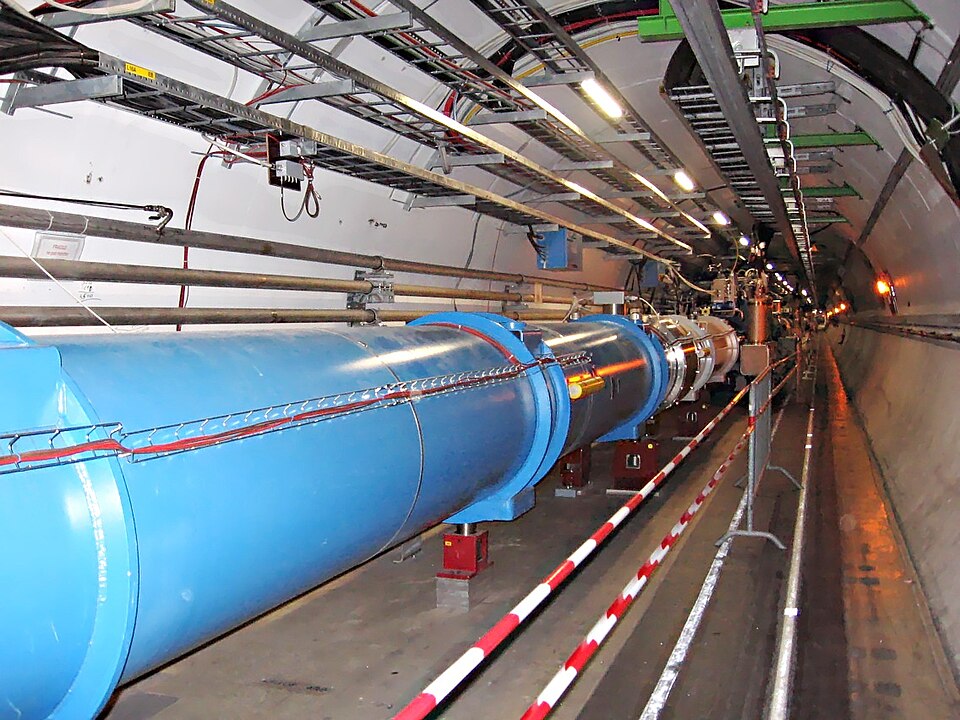
begins replacing 28 collider magnets with niobium-tin magnets, a first for working accelerators.
began dismantling parts of the on September 7 to replace 28 magnets that focus proton beams before collisions. The new magnets use niobium-tin, a material that works in stronger magnetic fields, and are the first of their kind used in a working accelerator.
The collider has been switched off since late June 2026. The upgrade is scheduled to start in June 2030, about a year later than first planned.
The upgrade aims to raise the number of proton collisions at each crossing from about 60 to between 140 and 200, giving scientists more chances to detect rare events and gather data.
Sources 1
- L
Latest from TechRadar AU
Since September 7, teams on either side of the ATLAS and CMS experiments have been dismantling the machine to remove 28 superconducting magnets
↗ - L
Since September 7, teams on either side of the ATLAS and CMS experiments have been dismantling the machine
↗ - L
to remove 28 superconducting magnets
↗ - L
Their replacements are made from niobium-tin (Nb3Sn)
↗ - L
The replacements are the first Nb3Sn magnets ever run in a working accelerator
↗ - L
a superconductor that keeps working in far stronger magnetic fields than the niobium-titanium (NbTi) the LHC was built with
↗
- L
The Large Hadron Collider has been switched off since late June 2026
↗ - L
The High-Luminosity LHC (HL-LHC), now scheduled to start in June 2030
↗ - L
The High-Luminosity LHC is scheduled to start up in June 2030, about a year later than originally planned
↗
The European Organization for Nuclear Research, also called European Laboratory for Particle Physics, known as CERN, is an intergovernmental organization that operates the largest particle physics laboratory in the world. Established in 1954, it is based in Meyrin, a western suburb of Geneva, on the France–Switzerland border. It comprises 25 member states. Israel, admitted in 2013, is the only full member geographically out of Europe. CERN is an official United Nations General Assembly observer.
The Large Hadron Collider (LHC) is the world's largest and highest-energy particle accelerator as of 2026. It was built by the European Organization for Nuclear Research (CERN) between 1998 and 2008, in collaboration with over 10,000 scientists, and hundreds of universities and laboratories across more than 100 countries. It lies in a tunnel 27 kilometres (17 mi) in circumference and as deep as 175 metres (574 ft) beneath the France–Switzerland border near Geneva.