Bureau warns of a warm week across Australia with pockets reaching mid to high thirties.
will see three warm days early in the week before showers move in Thursday and linger into the weekend, with daily highs around 20–23°C and a recent 30.3°C reading on September 16.
The says much of the country will warm back up, with parts of the and northern likely to hit the mid to high thirties, and -area highs pushing into the 30s.
and are expected to reach their highest September levels since 2023, while could post its warmest September readings since 2019; some places may sit up to 15°C above average.
Showers are forecast in from Thursday onward, and the Bureau urges people to check updates as the warm pattern continues into next weekend.
Sources 5
- PPerth urged to bundle up for Grand Final as cold front hitsWed 23 Sept, 1:18pm↗
perthnow.com.au3 articles
- GAdelaide weather forecast for Wednesday September 23rd and the days aheadWed 23 Sept, 6:38am↗
Glam Adelaide5 articles
4 more from Glam Adelaide
Adelaide weather forecast for Tuesday September 22 and the days aheadTue 22 Sept, 6:40am↗Adelaide weather forecast for Monday September 21 and the days aheadMon 21 Sept, 6:37am↗Adelaide weather forecast for Sunday September 20 and the days aheadSun 20 Sept, 8:02am↗Adelaide weather forecast for Saturday September 19th and the days aheadSat 19 Sept, 8:28am↗ - YAussie capital’s temps plunge 10C in 30mMon 21 Sept, 8:10pm↗
yahoo.com2 articles
1 more from yahoo.com
Hottest day to hit three Aussie citiesSun 20 Sept, 7:45am↗ - NAussie capital’s temps plunge 10C in 30mMon 21 Sept, 4:04pm↗
news.com.au2 articles
1 more from news.com.au
State’s dire threat of fires, 100km/h gustsSun 20 Sept, 7:41am↗ - NTemperature contrast drives snow, high fire danger in south-eastern AustraliaMon 21 Sept, 1:05pm↗
nine.com.au2 articles
1 more from nine.com.au
Parts of Australia to hit 10 degrees above average this weekendSat 19 Sept, 11:06am↗
About
South Australia is a state in the southern central part of Australia. With a total land area of 984,314 square kilometres (380,046 sq mi), it is the fourth-largest of Australia's states and territories by area, which includes some of the most arid parts of the continent. It is the 17th-largest subdivision in the world and the fifth-largest in Australasia. It is the second-most highly centralised state in the nation after Western Australia, with more than 67% of the 1.9 million South Australians living in the capital Adelaide or its environs. Other population centres in the state are relatively small; Mount Gambier is the second-largest centre, with a population of 26,878.
About
Adelaide is the capital and most populous city of South Australia, as well as the fifth-most populous city in Australia. The name "Adelaide" may refer to either Greater Adelaide or the Adelaide central business district; the demonym Adelaidean is used to denote the city and the residents of Adelaide. The traditional owners of the Adelaide region are the Kaurna, with the name Tarndanya referring to the area of the city centre and surrounding Park Lands, in the Kaurna language. Adelaide is situated on the Adelaide Plains north of the Fleurieu Peninsula, between the Gulf St Vincent in the west and the Mount Lofty Ranges in the east. Its metropolitan area encompasses over 430 suburbs, extending 96 km (60 mi) from Gawler in the north to Sellicks Beach in the south and 20 km (12 mi) from the western coast to the eastern foothills of the Mount Lofty Ranges.
About
Western Australia is the westernmost state of Australia. It is bounded by the Indian Ocean to the north and west, the Southern Ocean to the south, the Northern Territory to the north-east, and South Australia to the south-east. Western Australia is Australia's largest state, with a land area of 2,527,013 square kilometres (975,685 sq mi), and is also the second-largest subdivision of any country on Earth.
About
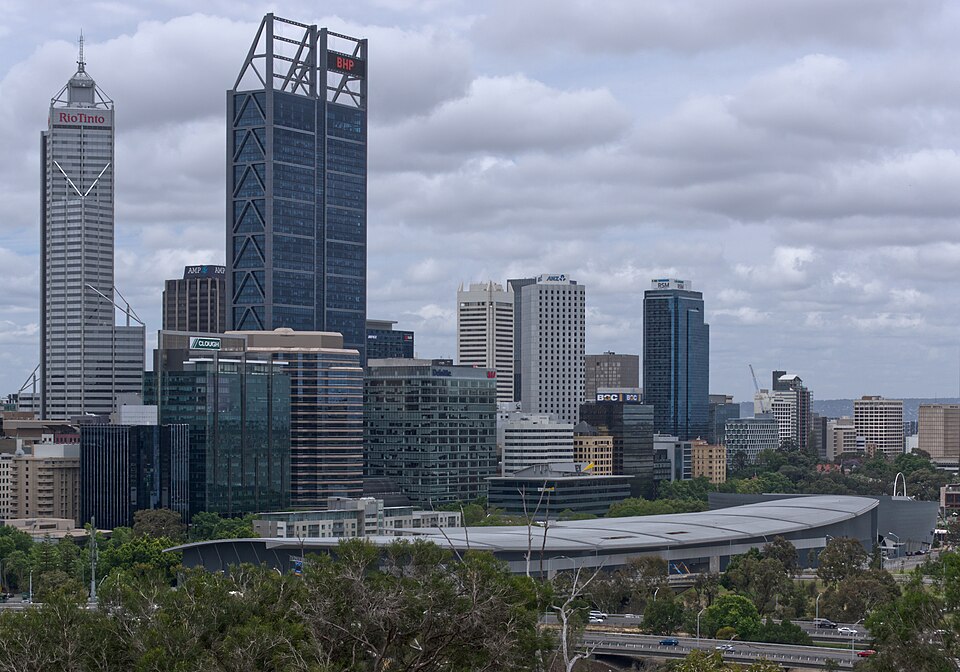
Perth is the capital and largest city of the state of Western Australia. It is the fourth-most-populous city in Australia, with a population of over 2.2 million in the city and 2.3 million within Greater Perth as of 2023. The world's most isolated city by certain criteria, Perth is part of the South West Land Division of Western Australia, with most of Perth's metropolitan area on the Swan Coastal Plain between the Indian Ocean and the Darling Scarp. The city has expanded outward from the original British settlements on the Swan River, upon which its central business district and port of Fremantle are situated.
About
Sydney is the capital of the state of New South Wales and the largest city in Australia. The metropolis surrounds Sydney Harbour and extends about 80 kilometres (50 mi) from the Pacific Ocean in the east to the Blue Mountains in the west, and about 80 kilometres (50 mi) from Ku-ring-gai Chase National Park and the Hawkesbury River in the north and north-west, to the Royal National Park and Macarthur in the south and south-west. Greater Sydney consists of 658 suburbs, spread across 33 local government areas. Residents of the city are colloquially known as "Sydneysiders". The estimated population in June 2025 was 5,638,830, which is about 66% of the state's population. The city's nicknames include the Emerald City and the Harbour City.
About
Melbourne is the capital and most populous city of the Australian state of Victoria and the second-most populous city in Australia. The city's name generally refers to a 9,993-square-kilometre (3,858 sq mi) area, comprising an urban agglomeration of 30 local government areas. The name is also used specifically to refer to the local government area, also named the City of Melbourne, whose administrative area is centred on the Melbourne central business district and some immediate surrounds.
About
The Bureau of Meteorology is an agency of the Australian Government that is responsible for providing weather forecasts and meteorological services to Australia and neighbouring countries. It was established in 1906 under the Meteorology Act 1955 (Cth), and brought together the state meteorological services that existed before then. The states officially transferred their weather recording responsibilities to the Bureau of Meteorology on 1 January 1908.
About
Hobart is the capital and most populous city of the island state of Tasmania, Australia. Located in Tasmania's south-east on the estuary of the River Derwent, it is the southernmost capital city in Australia. Despite containing nearly half of Tasmania's population, Hobart is the least-populated Australian state capital city, and second-smallest by population and area after Darwin if territories are taken into account. Its skyline is dominated by the 1,271-metre (4,170 ft) kunanyi / Mount Wellington, and its harbour forms the second-deepest natural port in the world, with much of the city's waterfront consisting of reclaimed land. The metropolitan area is often referred to as Greater Hobart, to differentiate it from the City of Hobart, one of the seven local government areas that cover the city. It has a mild maritime climate.
About
The Northern Territory is an Australian internal territory in the central and central-northern regions of Australia. The Northern Territory shares its borders with Western Australia to the west, South Australia to the south, and Queensland to the east. To the north, the Northern Territory looks out to the Timor Sea, the Arafura Sea, and the Gulf of Carpentaria, including Western New Guinea and various other islands of the Indonesian archipelago.
More on State (polity) · Bureau of Meteorology