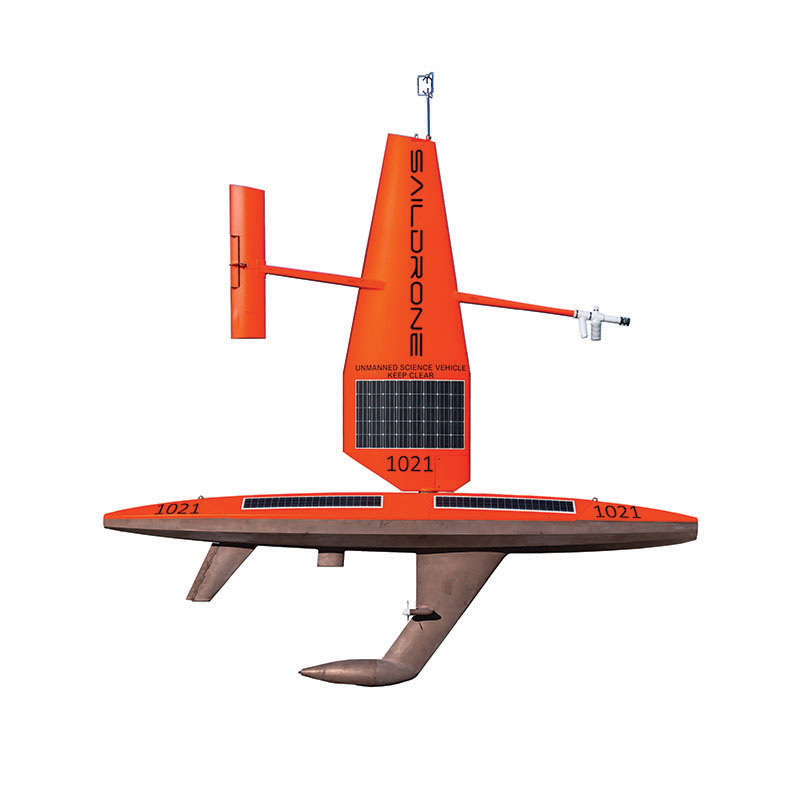
A seven-metre uncrewed vessel will circle Antarctica on a 22,000km climate mission.
The mission begins from as a seven-metre, hi‑vis orange craft that looks like a large kayak and is entirely uncrewed.
It will travel about 22,000km east from Hobart, through the Drake Passage and past before returning to be picked up.
Propelled by powerful winds and solar energy, the vessel is fitted with a heavy keel, rudder and a fixed solar sail to stay upright and steered remotely.
Its goal is to measure wind, pressure, solar radiation, temperature, salinity, chlorophyll and carbon dioxide in water and air to understand ocean sinks for carbon.
Dr Elizabeth Shadwick says the craft is “quite a robust little device” after already facing eight‑metre waves and 35‑knot winds, and the company will monitor and nudge it via satellite if needed.
This is the first of a planned fleet of four, with more launched every three months and data available in near real time for scientists after quality checks.
Sources 8
- 7Aussies urged to apply for hundreds of jobs on offer in AntarcticaFri 2 Oct, 10:33pm↗
7NEWS
- NOnce-in-a-lifetime opportunity to work in AntarcticaFri 2 Oct, 5:55am↗
nine.com.au2 articles
1 more from nine.com.au
China plans sixth Antarctic stationWed 30 Sept, 10:41am↗ - 9There are around 250 vacant jobs up for grabs for qualified tradies to work for the federal…Thu 1 Oct, 7:14pm↗
9news
- PAuroras, penguins: life at an Antarctic outpostThu 1 Oct, 5:01am↗
perthnow.com.au2 articles
1 more from perthnow.com.au
Antarctic blind spot emerges as major sea-level threatWed 30 Sept, 9:01am↗ - N‘Extreme’: Aussie shares life living and working in Antarctica as major recruitment drive kicks offWed 30 Sept, 1:39pm↗
news.com.au
- TTragedy stopped Mawson exploring this remote Antarctic region. We must get there to study its melting iceWed 30 Sept, 9:00am↗
The Conversation (AU)
- A'Open your eyes': Why China's sixth Antarctic base is raising concernsSun 27 Sept, 2:20pm↗
ABC News - Victoria Top Stories
- T‘Robust little’ vessel begins treacherous 22,000km journey around Antarctica in the name of climate scienceSat 26 Sept, 1:00am↗
The Guardian - Australia News
About
Hobart is the capital and most populous city of the island state of Tasmania, Australia. Located in Tasmania's south-east on the estuary of the River Derwent, it is the southernmost capital city in Australia. Despite containing nearly half of Tasmania's population, Hobart is the least-populated Australian state capital city, and second-smallest by population and area after Darwin if territories are taken into account. Its skyline is dominated by the 1,271-metre (4,170 ft) kunanyi / Mount Wellington, and its harbour forms the second-deepest natural port in the world, with much of the city's waterfront consisting of reclaimed land. The metropolitan area is often referred to as Greater Hobart, to differentiate it from the City of Hobart, one of the seven local government areas that cover the city. It has a mild maritime climate.
About
South Africa, officially the Republic of South Africa (RSA), is the southernmost country in Africa. The country consists of nine provinces, and is bounded to the south by 2,798 kilometres of coastline that stretches along the South Atlantic and Indian Ocean; to the north by the neighbouring countries of Namibia, Botswana, and Zimbabwe; and to the east and northeast by Mozambique and Eswatini. South Africa also encloses Lesotho. Covering an area of 1,221,037 square kilometres, the country has a population of over 63 million people, making it the sixth-most populated country in Africa, and 24th-most in the world. Pretoria is the administrative capital, while Cape Town, as the seat of Parliament, is the legislative capital, and Bloemfontein is regarded as the judicial capital. The largest and most populous city is Johannesburg, followed by Cape Town and Durban.
About
The westerlies, anti-trades, or prevailing westerlies, are prevailing winds from the west toward the east in the middle latitudes between 30 and 60 degrees latitude. They originate from the high-pressure areas in the horse latitudes and trend towards the poles and steer extratropical cyclones in this general manner. Tropical cyclones which cross the subtropical ridge axis into the westerlies recurve due to the increased westerly flow. The winds are predominantly from the southwest in the Northern Hemisphere and from the northwest in the Southern Hemisphere.
More on United States · New Zealand · Russia · People's Republic of China