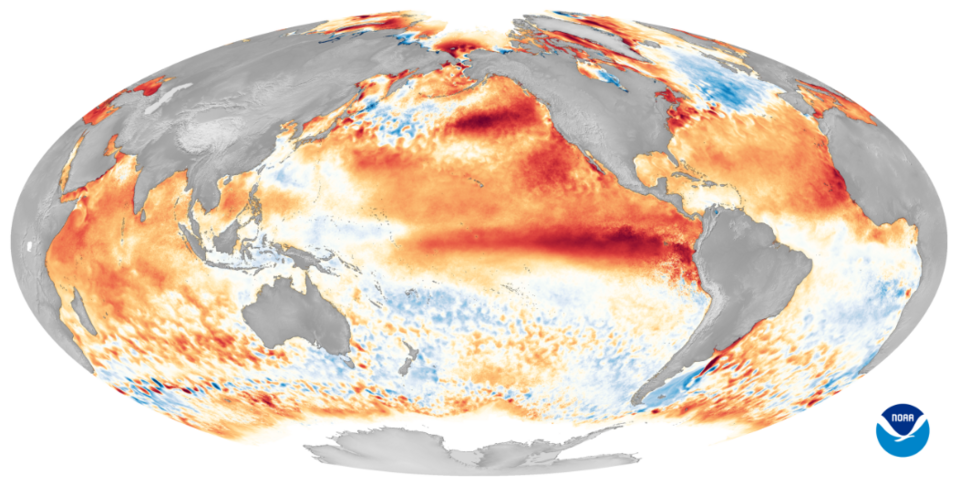
A powerful El Niño could cause 451,000 extra heat-related deaths between June 2026 and February 2027.
The –based Climate Impact Lab says an unusually strong , on top of human-caused warming, could cause 451,000 additional heat-related deaths worldwide from June 2026 through February 2027.
Researchers estimate global land temperatures may be about 1.2C higher during this El Niño, producing 44% more extremely hot days than a typical year and raising heat risk everywhere.
The heaviest toll is expected in poorer countries in the Global South, with the hardest hit at about 66,800 additional deaths; other hotspots include , , and parts of South and .
To limit deaths the study urges measures such as heat-warning systems, cooling centres, protections for outdoor workers and targeted outreach, and it calls specifically for anticipatory financing so governments can move resources before heat peaks.
Sources 4
- YHawaii under another hurricane watch as new storm closes inThu 24 Sept, 10:46pm↗
yahoo.com4 articles
3 more from yahoo.com
Colossal hurricane blooms into ‘truly historic’ behemoth as it threatens flash floods, mudslidesWed 23 Sept, 11:03am↗Hurricane Polo grows into powerful Category 5 storm off Mexico. See its path.Wed 23 Sept, 10:22am↗https://yahoo.com/news/hurricane-polo-becomes-rare-category-130334546.htmlWed 23 Sept, 5:47am↗ - 7Hurricane Polo grows into ‘one of the strongest’ Pacific storms everWed 23 Sept, 7:12pm↗
7NEWS
- NPanic as hurricane morphs into Cat 5 beastWed 23 Sept, 5:51pm↗
news.com.au
- PSuper El Nino weather event could cause 451,000 deathsWed 23 Sept, 3:47pm↗
perthnow.com.au
The COP31 draft deal dropped fossil fuel language, while El Niño in Africa prompted Ugandan activists to demand better disaster preparedness as the phenomenon threatens their communities.
20 NovAbout
El Niño–Southern Oscillation (ENSO) is a global climate phenomenon that emerges from variation in winds and sea surface temperatures over the tropical Pacific Ocean. Those variations have an irregular pattern, but do have some appearance of cycles. The occurrence of ENSO is not easily predictable. It affects the climate of much of the tropics and subtropics, and has links (teleconnections) to higher-latitude regions of the world. The warming phase of the sea surface temperature is known as "El Niño" and the cooling phase as "La Niña". The Southern Oscillation is the accompanying atmospheric oscillation, which is coupled with the sea temperature change.
About
Brazil, officially the Federative Republic of Brazil, is the largest country in South America. It is also the world's fifth-largest country by area and the seventh-largest by population, with over 214 million people. Brazil is a federation composed of 26 states and a Federal District, which hosts the capital, Brasília. Its most populous city is São Paulo, followed by Rio de Janeiro. Brazil has the largest Lusophone population in the world and is the only Portuguese-speaking country in the Americas, where it is the official language.
About
India, officially the Republic of India, is a country in South Asia. It is the world's seventh-largest country by area and its most populous. Bounded by the Indian Ocean on the south, the Arabian Sea on the southwest, and the Bay of Bengal on the southeast, it shares land borders with Pakistan to the west, China, Nepal, and Bhutan to the north, and Bangladesh and Myanmar to the east. In the Indian Ocean, India is near Sri Lanka and the Maldives.
About
Indonesia, officially the Republic of Indonesia, is a country in Southeast Asia and Oceania, between the Indian and Pacific oceans. Comprising between 13,000 and 17,000 islands—including Sumatra, Java, Sulawesi, and parts of Borneo and New Guinea—it is the world's largest archipelagic state and the 14th-largest country by area. Indonesia has extensive tropical forests and marine ecosystems that support some of the world's highest levels of biodiversity.
About
The Sahel region, or Sahelian acacia savanna, is a biogeographical region in Africa. It is the transition zone between the more humid Sudanian savannas to its south and the drier Sahara to the north. The Sahel has a hot semi-arid climate and stretches across the southernmost latitudes of North Africa between the Atlantic Ocean and the Red Sea. Although geographically located in the tropics, the Sahel does not have a tropical climate.
About
Southeast Asia is the geographical south-eastern subregion of Asia, consisting of the regions that are situated south of China, east of the Indian subcontinent, and northwest of mainland Australia, which is a part of Oceania. Southeast Asia is bordered to the north by East Asia, to the west by South Asia and the Bay of Bengal, to the east by Oceania and the Pacific Ocean, and to the south by Australia and the Indian Ocean. Apart from the British Indian Ocean Territory and two out of 26 atolls of Maldives in South Asia, Maritime Southeast Asia is the only other subregion of Asia that lies partly within the Southern Hemisphere. Mainland Southeast Asia is entirely in the Northern Hemisphere. Timor-Leste and the southern portion of Indonesia are the parts of Southeast Asia that are located south of the Equator.
About
The University of Chicago is a private research university in the Hyde Park community area of Chicago, Illinois, United States.
More on United States · Instagram · 2026 Iran war · India